Summary
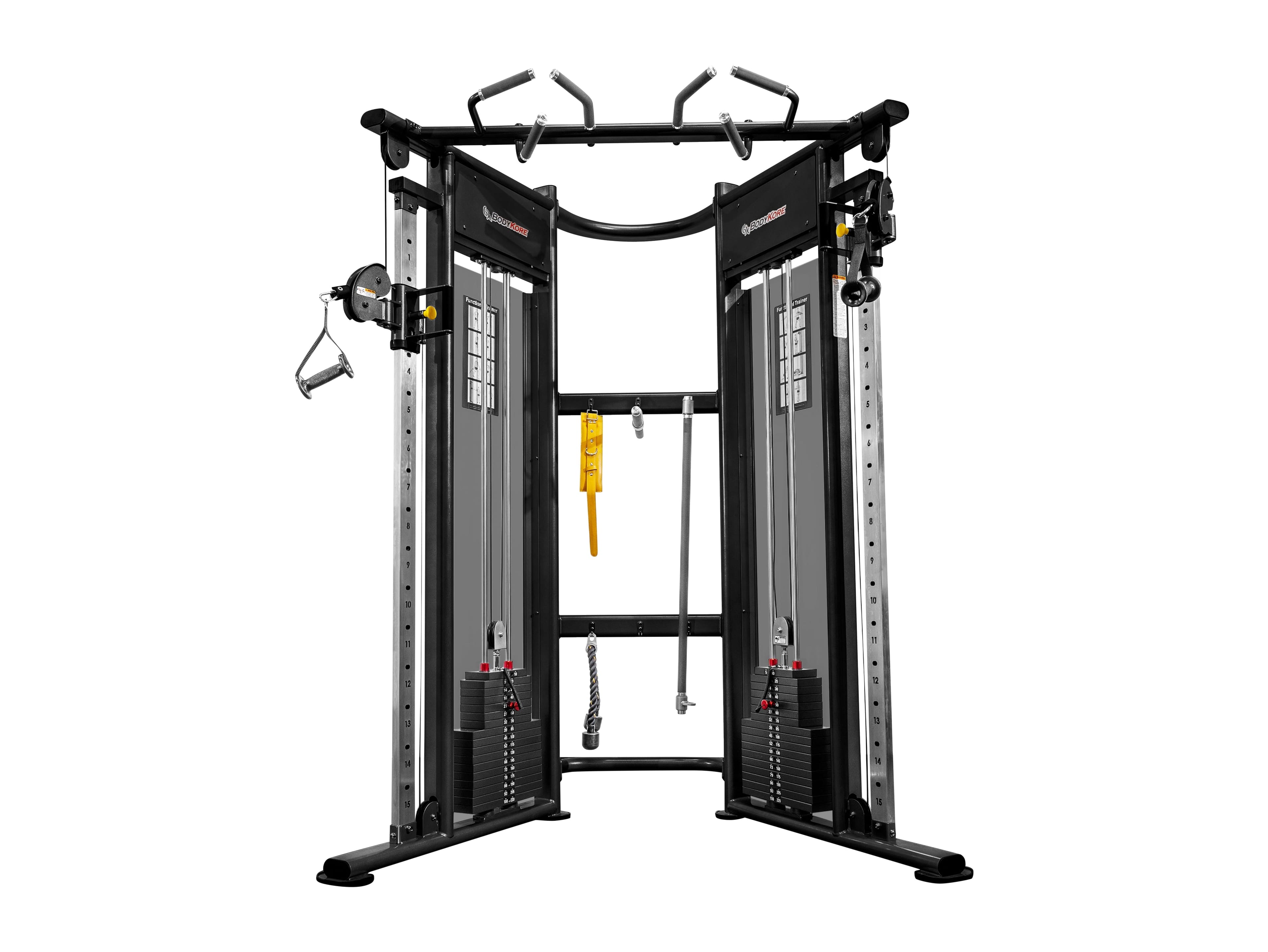
Machine footprint: most functional trainers are about 4 to 6 feet wide and 3 to 5 feet deep, though compact models are smaller and commercial ones larger.
Add clearance: leave roughly 2 to 3 feet on each side and about 3 feet in front so you can move through cable exercises freely.
Total room: plan for a usable area of around 8 by 10 feet for a full machine, less for a compact unit.
Ceiling is the dealbreaker: machines stand 80 to 93 inches tall, and you need extra height above that for pull-ups and overhead work.
Tight space options exist: compact and wall-mounted models, plus rack-mounted cable attachments, fit rooms a full unit cannot.
It is the question that stops most home gym plans in their tracks: will a functional trainer fit? The short answer is that a typical machine needs a footprint of roughly 4 to 6 feet wide and 3 to 5 feet deep, but the space you need is larger, because you have to add clearance around it to use the cables. Most setups work in a floor area of about 8 by 10 feet, and the factor that catches people out is the ceiling height above the machine.
This guide gives you the real numbers: how big functional trainers are, how much clearance to leave around the machine, the ceiling height you need for overhead and pull-up movements, and how to measure your room before you buy. It also covers compact and low-ceiling options for tight spaces, so you can find a machine that fits the room you have.
Typical Functional Trainer Dimensions
Functional trainers vary a lot in size, so the first step is knowing the range. Width runs from about 44 inches on compact models to 79 inches on large commercial units. Depth runs roughly 30 to 67 inches, and height 80 to 93 inches. A small home model like a compact dual-pulley trainer might occupy only 11 square feet of floor, while a full commercial unit can push past 70 inches wide and 60 inches deep. The table below groups the common size classes with a realistic room minimum for each.
Size class | Footprint (W x D) | Height | Minimum room |
Compact / home | 44-53 in x 30-40 in | 80-83 in | About 8 x 9 ft |
Mid-size | 54-64 in x 40-53 in | 82-86 in | About 9 x 10 ft |
Full / commercial | 64-79 in x 53-67 in | 84-93 in | About 9 x 11 ft or more |
These figures include the working clearance you need around the machine rather than just the frame itself, which is why the room minimum is larger than the footprint. Always check the exact specifications of the model you are considering, since two machines with similar stacks can differ by a foot or more in width and depth.
Footprint Versus Usable Space
The single most common planning mistake is reading the footprint on a spec sheet and assuming that is all the room you need. The footprint is the size of the machine standing still and unused. The usable space is what you need to train, and it is always larger. A good working rule is to add 20 to 30 percent to the listed dimensions to account for body movement, or to put it plainly, to leave a clear buffer on the sides and front.
On the sides, leave about 2 to 3 feet of clearance so you can open your arms fully for cable flyes and crossovers without hitting a wall or the machine. In front, plan for roughly 3 feet, and ideally more, so you can step back from the pulleys for movements like rows and squats, where the cable needs room to travel. Stack it all up and a machine with a 5-foot-wide footprint comfortably wants a 9- to 10-foot-wide space once clearance is added. The clearance matters as much as the footprint, because a machine crammed against a wall is a machine you cannot use properly.
That said, do not over-believe the inflated figures floating around online. You do not need a 12-by-15-foot room for a single functional trainer. A realistic, comfortable home setup fits a full machine and its clearance in roughly 8 by 10 feet, and a compact model fits in less. Measure honestly, leave real working room, and you will be fine without dedicating an entire garage to one station.
Why Ceiling Height Matters Most
If a functional trainer purchase goes wrong, ceiling height is usually why. The machine frame itself stands roughly 80 to 93 inches tall, and most fall in the 80 to 88 inch range, which already crowds a standard 8-foot ceiling of 96 inches. The catch is that you need clearance above the frame, rather than only room for it to stand.
For overhead pressing and especially for using the pull-up bar that tops many machines, a good rule is to add 12 to 18 inches to the machine's listed height for safe movement. That means an 80-inch machine really wants about 94 to 98 inches of ceiling, and a taller machine needs more. There is a second trap, too: floor matting. The rubber flooring that protects your floor and dampens noise adds 3 to 4 inches of height, which cuts into your ceiling clearance. If you are tall or you want to do pull-ups, plan for 8.5 to 9 feet of clearance or more. A ceiling under 84 inches creates real limitations, and in that case you should look at a low-ceiling model or focus on seated and lower-pulley exercises.
Vertical measurement | What to allow |
Machine frame height | Roughly 80 to 93 inches, depending on model |
Overhead and pull-up clearance | Add 12 to 18 inches above the frame |
Floor matting | Subtract 3 to 4 inches from your ceiling |
Comfortable target with a pull-up bar | About 8.5 to 9 feet or more |
How to Measure Your Space Before Buying
A few minutes with a tape measure saves an expensive mistake. Work through these steps before you order anything, and remember the first rule of gym planning: measure twice, buy once.
Measure the room: record the length and width along with the ceiling height, taking the ceiling at its lowest point, including beams, joists, garage door tracks, and light fixtures.
Account for the floor: if you will lay rubber matting, subtract its thickness from your ceiling height, since 3 to 4 inches can be the difference between fitting and not.
Draw the footprint to scale: sketch the machine's width and depth on your floor plan, then add the side and front clearance zones around it.
Check the ceiling math: compare your ceiling height against the machine's height plus the 12 to 18 inches you need for overhead and pull-up work.
Plan the delivery path: these machines are heavy and ship in large boxes, so confirm doorways and stairwells can fit them, along with any tight turns.
Leave a walkway: keep a clear path to get in and out and reach the pulleys, rather than boxing the machine in completely.
Options for Small or Low-Ceiling Spaces
If your room is tight, you still have good options, since manufacturers have responded to the reality that most people do not have a dedicated gym. The point is to match the machine to your constraints rather than forcing a full commercial unit into a space that cannot take it.
Compact functional trainers: space-saving models with a footprint as small as 44 to 53 inches wide are built for apartments and basements, or any multi-use room.
Wall-mounted units: some functional trainers mount to a wall and fold flat when not in use, freeing the floor entirely between workouts.
Low-ceiling models: a few machines are built for ceilings under 8 feet, trading some overhead range for a shorter frame.
Rack-mounted cable attachments: if you already own a power rack, a cable attachment adds functional-trainer capability without a separate machine.
Corner placement: positioning the unit in a corner can preserve open floor in the rest of the room, as long as you keep side clearance for the cables.
It is also worth knowing how a functional trainer compares with the alternatives on space. It is more compact than a full cable crossover, which spreads its columns 6 to 8 feet apart and needs far more width. It is comparable to a power rack in floor area, though the rack needs extra width for loading a barbell. For most home gyms, the functional trainer is one of the more space-efficient ways to get a huge range of exercises from a single machine.
Putting It All Together
A functional trainer needs more room than its footprint suggests, but less than the internet often claims. Budget for a machine roughly 4 to 6 feet wide and 3 to 5 feet deep, add 2 to 3 feet of clearance on the sides and about 3 feet in front, and you land at a comfortable working area of around 8 by 10 feet for a full unit. Compact and wall-mounted models fit considerably less.
Above all, check your ceiling. The frame runs 80 to 93 inches tall, you need another foot or so above it for pull-ups and presses, and floor matting takes a few inches more, so a standard 8-foot ceiling is workable but tight. Measure your room carefully, including the height at its lowest point, then compare it against the exact model's specifications and confirm the delivery path. Do that, and you will end up with a machine that fits your space and gets used, which is the whole point.
Frequently Asked Questions
What is the minimum room size for a functional trainer?
For a full-size machine with proper clearance, plan for about 8 by 10 feet of floor space, which fits the frame plus room to move through cable exercises. A compact model can work in roughly 8 by 9 feet or even less. The exact minimum depends on the model's footprint, so always add 2 to 3 feet of side clearance and about 3 feet of front clearance to whatever the spec sheet lists.
Can a functional trainer fit under an 8-foot ceiling?
Often yes, but it is tight. Most frames stand 80 to 88 inches tall, which leaves only a few inches under a 96-inch ceiling, and floor matting reduces that further. You can press and do most exercises, but full overhead pull-ups may be cramped. If your ceiling is below about 84 inches, look at a low-ceiling model and lean on seated and lower-pulley movements.
How much ceiling height do I need for pull-ups on a functional trainer?
Plan to add 12 to 18 inches above the machine's frame height for safe pull-up and overhead use, then account for your own height with arms extended. In practice, that usually means a ceiling of about 8.5 to 9 feet or more, especially if you are tall. Remember to subtract any floor matting from your available height before deciding.
How much clearance do I need around the machine?
Leave roughly 2 to 3 feet on each side so you can fully extend your arms for flyes and crossovers, and about 3 feet in front, ideally more, so you can step back for rows and squats while the cable travels. Clearance is as important as the footprint, because a machine pushed against a wall limits the exercises you can perform.
Are functional trainers good for small home gyms?
Yes, particularly the compact and wall-mounted models. A functional trainer replaces several separate machines, so it is one of the most space-efficient ways to build a complete home gym. As long as you have the ceiling height and a few feet of clearance, even a spare room or a garage corner can house one, and tighter spaces have purpose-built compact options.
Also Read
Functional Trainer vs Smith Machine: Which Is Right for Your Gym?Functional Trainer vs Cable Crossover Machine: Which Should You Buy?Trending Now
25 Best Functional Trainer Exercises for a Full-Body Workout
Functional Trainer Leg Exercises: The Complete Guide
Beginner Cable Machine Workout Plan: 8 Weeks
Newsletter
Enter your email and be the first to get the latest blog posts, news, product launches and more from BodyKore.
Stay in the Know
Enter your email and be the first to get the latest blog posts, news, product launches and more from BodyKore.