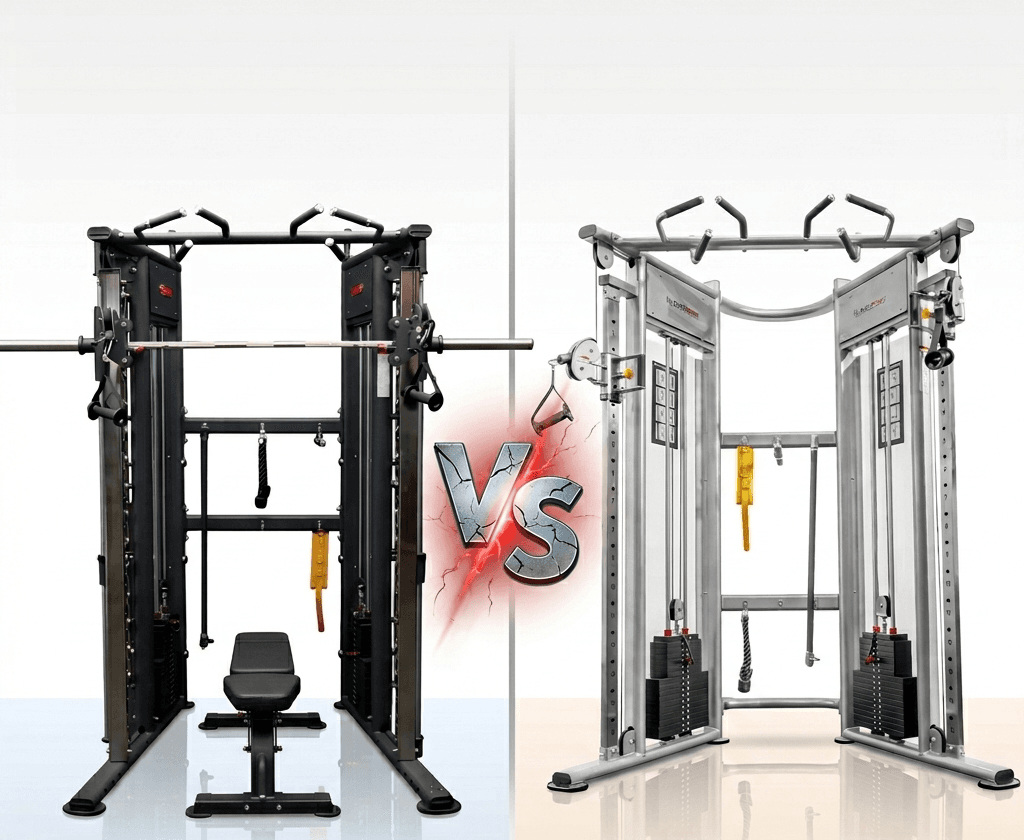
The Quick Rundown
Different jobs: a functional trainer is built for versatility and free movement; a Smith machine is built for heavy, stable barbell lifting.
Movement: the functional trainer moves freely in every direction, while the Smith machine locks the bar to a fixed vertical path.
Strength vs variety: the Smith machine loads heavier for big compound lifts; the functional trainer covers hundreds of exercises the Smith cannot.
Muscle: the functional trainer trains your stabilizers and core; the Smith machine removes them so you can isolate and lift more.
Best for whom: choose the functional trainer for full-body and functional training, the Smith machine for heavy barbell work and beginners.
Or both: combo machines pair a functional trainer with a Smith machine in one frame, which is the popular answer for home gyms with the room.
Two machines dominate the conversation when people build a serious home or commercial gym: the functional trainer and the Smith machine. Both let you train hard and safely without a spotter, both show up on a lot of gym floors, and both cost real money, so picking the wrong one is an expensive mistake. The catch is that they are built for almost opposite jobs. One gives you complete freedom of movement, while the other gives you a locked, predictable bar path, and that single difference shapes everything else.
This comparison breaks down how the two stack up across the factors that matter: movement and range of motion, muscle activation, maximal strength, versatility, safety, joint impact, space, and price. By the end you will know which machine fits your goals and your space, within your budget, and whether the smartest answer might be a unit that combines both.
What Each Machine Is
Before the head-to-head, it helps to be clear on what each machine does, since their designs explain every difference that follows.
The functional trainer
A functional trainer is a cable machine built around two adjustable pulleys that travel up and down a pair of uprights, each connected to its own weight stack. You clip on handles, ropes, or bars and train against the cables, and because the pulleys move and the cables pull from any angle, the machine offers an unrestricted, roughly 360-degree range of motion. You can press, pull, squat, curl, and rotate across every plane, including the diagonal and lateral lines a fixed bar cannot follow, which is what makes it so effective for athletic training and core work, along with any exercise that does not fit neatly into a straight line. A single unit replaces several separate cable stations.
The Smith machine
A Smith machine is a barbell fixed inside a frame, locked onto vertical or slightly angled steel rails so the bar travels on one guided, straight-line path. Integrated safety catches let you rack the bar at almost any point with a flick of the wrist, so the frame effectively spots you. That fixed path removes the need to balance and stabilize the bar yourself, which is the source of both its strengths and its limits. It is built for loaded barbell movements such as squats, bench presses, shoulder presses, and lunges, performed with control and heavy weight.
Free Motion vs a Fixed Path
Every other difference between these machines flows from one thing: how the weight moves. The functional trainer lets the resistance travel wherever your body takes it, in any direction, through cables. The Smith machine confines the barbell to a single fixed line. That is the whole comparison in miniature, because freedom of movement and a locked path each come with a distinct set of trade-offs.
Free motion means you have to control the weight in every direction, which recruits your stabilizing muscles and lets you train natural, real-world movement patterns, but it caps how much load you can safely handle. A fixed path means the machine handles your balance for you, so you can load more weight and target a muscle precisely, but you give up the stabilizer work and some natural range of motion. Neither is better in the abstract. They serve different priorities, which the comparison below makes concrete.
The Head-to-Head Comparison
The table summarizes the matchup at a glance, and the sections that follow dig into the factors that should drive your decision.
Factor | Functional trainer | Smith machine |
Movement | Free, roughly 360-degree, multiplanar | Fixed vertical or near-vertical path |
Muscle focus | Engages stabilizers and core; constant tension | Isolates the target; minimal stabilizer demand |
Maximal load | Limited by the weight stack, especially for legs | Very heavy; often 10% to 15% more than free weights |
Versatility | Hundreds of exercises across every plane | Mainly vertical barbell lifts |
Safety | Release the handles and the stack returns | Safety catches rack the bar anywhere |
Joint impact | Joint-friendly, follows your natural path | Fixed path can strain some joints |
Best for | Versatility, core, rehab, athletic training | Heavy compound lifts, beginners, mass |
Footprint | Medium, needs clearance on both sides | Medium to large, needs depth and height |
Movement and range of motion
This is the central difference. The functional trainer offers a completely unrestricted path, letting you move on the diagonal and through rotation, which is ideal for sports-specific training and any movement that lives outside a vertical plane. The Smith machine does the opposite: it fixes the bar to a vertical or slightly angled track, which limits your range of motion but guarantees the weight stays on a predictable line. If you value moving the way your body does on its own, the functional trainer wins easily. If you want a locked path for focused, repeatable heavy lifting, the Smith machine delivers exactly that.
Muscle activation and strength
The two machines load your muscles in different ways. Because you must control the cables in every direction, the functional trainer recruits your core and stabilizing muscles on nearly every rep, and the cables keep constant tension on the working muscle through the full range. The Smith machine takes the opposite approach: by removing the balance demand, it lets you stop worrying about stabilizers and pour all your effort into the target muscle, which is excellent for isolation and training to failure. That stability also lets you lift heavier. A commonly cited rule of thumb holds that you can move roughly 10% to 15% more weight on a Smith machine than with a free barbell, which is why it excels at heavy compound lifts and building mass.
Versatility and exercise variety
Here the functional trainer is far ahead. With adjustable pulleys and a library of attachments, it handles hundreds of exercises across every muscle group, like cable rows, chest flyes, single-arm presses, rotational chops, and full-body movements. The Smith machine, by design, does a smaller set of things: the vertical barbell lifts like squats, presses, rows, and shrugs. Those are valuable movements, but the functional trainer covers far more, which is the main reason many lifters consider it the more complete single purchase, especially for upper-body and core training.
Safety and solo training
Both machines are designed to let you train hard alone, just through different mechanisms. The Smith machine spots you with its safety catches: if a rep stalls, you twist the bar and it locks onto the rails, so a stalled rep is never trapped on top of you. The functional trainer is inherently safe in a different way, since the resistance sits in a cable and a stack rather than a bar over your body. If you cannot finish a rep, you let go of the handles and the stack drops back into its housing. For heavy barbell squatting and pressing without a spotter, the Smith machine offers the more reassuring kind of safety; for everything else, the cable system removes the risk entirely.
Joint impact and functional carryover
This is where the fixed path costs the Smith machine. Because the bar travels on a set line regardless of your individual mechanics, it can place awkward stress on the knees or shoulders if that line does not match how your joints want to move. The functional trainer, by contrast, follows whatever path your body chooses, which makes the cable motion smooth and joint-friendly and a longtime favorite for rehabilitation and pain-free training. The same freedom gives it better functional carryover: training through natural, multi-joint patterns transfers more directly to sport and daily life than a fixed vertical path does. The Smith machine answers with raw strength on the big lifts, which carries over in its own way to overall mass and power.
Footprint and price
Both are substantial machines, but they eat space differently. A functional trainer has a medium footprint yet needs clearance on both sides so you can move freely through wide exercises, and the room it uses is often larger than it looks. A Smith machine needs depth for the bench and plate loading, plus enough ceiling height for overhead pressing and the bar's travel. On price, a basic standalone Smith machine is often the more budget-friendly entry point, while quality functional trainers tend to start higher, around $1,500 to $2,500 and climbing with features. Combo units that include both cost more, though less than buying two separate machines.
Which One Should You Choose?
The right pick comes down to your training goals and experience, and what you want the machine to do for you. The functional trainer and the Smith machine reward different priorities, so match the tool to your plan rather than to the hype.
Choose a functional trainer if: you want maximum versatility, full-body and core training, rotational and unilateral work, joint-friendly movement, or one machine that covers the most exercises in a compact space.
Choose a Smith machine if: your focus is heavy, structured barbell lifting, building mass through big compound movements, safe solo squatting and pressing, or a guided path that helps a beginner learn the lifts.
As a rough guide, the functional trainer suits most general home lifters and athletes, along with anyone training for fitness and longevity, because of its sheer range. The Smith machine earns its place for dedicated strength and physique training built around the heavy barbell lifts, and for newer lifters who want the confidence of a guided bar. If you mainly chase a bigger squat and bench, lean Smith; if you want to do a bit of everything, lean functional trainer.
The Combo Machine Option
For many home gym owners, the best answer to this debate is to refuse to pick. A growing category of all-in-one machines integrates a functional trainer and a Smith machine into a single frame, often alongside a power rack and a pull-up bar, with accessory storage too. These combo units give you the cable versatility of a functional trainer and the guided heavy lifting of a Smith machine in one footprint, which is more space-efficient and usually cheaper than buying the two as separate stations.
The trade-offs are real but modest. A combo machine costs more than a single standalone unit and takes up a fair amount of room. A few extreme movements can also feel slightly compromised compared with a dedicated machine. For the buyer who wants to do everything in one corner of the garage or the basement, though, the consolidation is hard to beat, and it sidesteps the entire functional trainer versus Smith machine question by giving you both. If your space and budget allow, a quality combination unit is often the most complete home gym you can build around a single machine.
Putting It All Together
The functional trainer versus Smith machine choice is less about which machine is better and more about which one matches how you want to train. The functional trainer is the versatility pick: free-moving cables, hundreds of exercises, strong core and stabilizer engagement, joint-friendly motion, and real functional carryover, and its only real limit is maximal load on the lower body. The Smith machine is the heavy-lifting specialist: a fixed, stable bar path that lets you load big compound movements safely on your own and isolate muscles for mass, at the cost of versatility and natural range of motion.
Decide by your goals. Pick the functional trainer for its breadth and movement quality, and the Smith machine for structured, heavy barbell strength. And if you would rather not choose, a combo unit delivers both in one frame. Whichever way you lean, understanding the trade-offs means you end up with the machine that fits your training rather than the one with the flashiest sales page.
Frequently Asked Questions
Is a functional trainer or Smith machine better for beginners?
The Smith machine is usually the easier starting point, because its guided bar path removes the balance demand and lets new lifters learn the main compound lifts with less complexity and more confidence. A functional trainer is also beginner-friendly and very safe, but its free motion asks for a bit more control. Many beginners do well starting on a Smith machine and adding cable work as they progress.
Can you build muscle with a functional trainer?
Yes, and effectively. The cables keep constant tension on the muscle through the entire range of motion, which drives strong activation and growth, and the machine covers enough exercises to train every muscle group. With sufficient resistance and progressive overload, a functional trainer builds muscle well across the upper body and core, though many lifters add heavier barbell work for maximal lower-body development.
Is a Smith machine good for squats?
It can be, with caveats. The fixed bar path makes Smith machine squats very stable and safe to perform solo, and it lets you load heavy while focusing on the quads and glutes without balancing the bar. The downside is that the locked vertical path does not suit everyone's natural squat mechanics and can stress the knees or back for some lifters. Used with good positioning, it is a solid squatting option, especially without a spotter.
Which takes up less space, a functional trainer or a Smith machine?
It depends on the model, and both need real room. A functional trainer has a moderate footprint but requires open clearance on both sides for wide cable movements, so its usable space is larger than the frame suggests. A Smith machine needs depth for benches and plates plus ceiling height for overhead work. Measure your space against the specific model, and if room is tight, a wall-mounted functional trainer or a compact combo unit can help.
Should I buy a functional trainer and Smith machine combo?
If your budget and space allow, a combo unit is often the smartest choice, since it delivers cable versatility and guided heavy lifting in one frame for less than two separate machines would cost. The trade-offs are a higher price than a single unit and a larger footprint, plus minor compromises on a few extreme movements. For a home gym that wants to do nearly everything around one machine, the combo is the strongest option.
Also Read: Functional Trainer vs Cable Crossover Machine: Which Should You Buy?
Trending Now
25 Best Functional Trainer Exercises for a Full-Body Workout
Functional Trainer Leg Exercises: The Complete Guide
Beginner Cable Machine Workout Plan: 8 Weeks
Newsletter
Enter your email and be the first to get the latest blog posts, news, product launches and more from BodyKore.
Stay in the Know
Enter your email and be the first to get the latest blog posts, news, product launches and more from BodyKore.