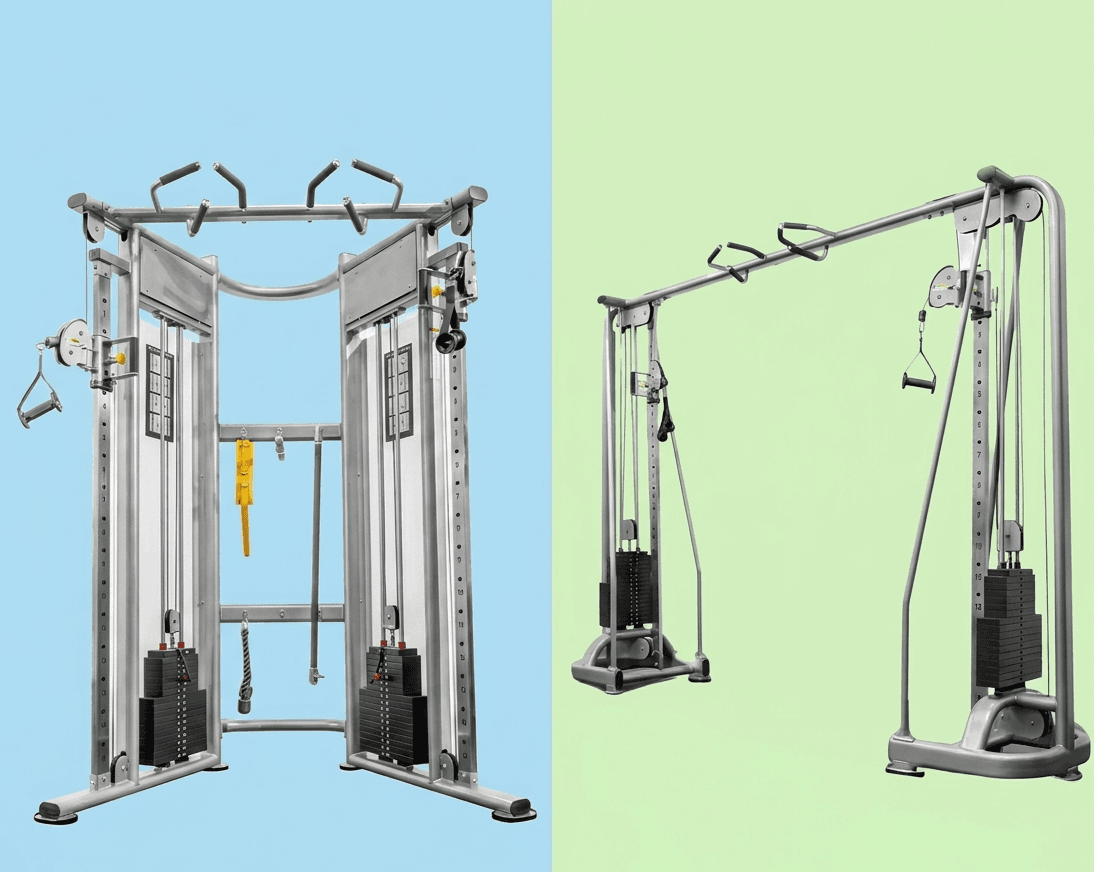
The Quick Rundown
Close cousins: both are dual-cable machines with adjustable pulleys, so they overlap heavily, but they are tuned for different priorities.
The big difference: a functional trainer's pulleys adjust to many heights and angles, while a cable crossover usually offers just a few fixed positions.
Versatility: the functional trainer handles hundreds of full-body exercises; the cable crossover is optimized for wide chest flyes and crossovers.
Space: the crossover is very wide and suits a large or commercial floor, while the functional trainer is compact enough for a home gym.
Resistance feel: crossovers often run a 1:1 ratio so you feel the full stack, while functional trainers commonly use 2:1 for finer increments.
Bottom line: pick the functional trainer for versatility in less space, the cable crossover for dedicated chest work where room is plentiful.
At first glance, a functional trainer and a cable crossover look like the same machine: two weight stacks and the cables you pull against. They belong to the same family, and either one can give you a great cable workout. Look closer, though, and the differences change how each machine is used. One is a compact, adjustable station that does almost everything; the other is a wide, specialized machine built around one signature movement.
This guide compares the two where it counts: how adjustable the pulleys are, how much floor space they need, what each does best, how the resistance feels, and what they cost. The differences are subtle on paper but decisive in practice, and by the end you will know which cable machine earns the space in your gym.
What Each Machine Is
Both machines share the same core: two weight stacks and a set of pulleys and cables. Their designs diverge in ways that shape everything else, so it pays to define each one clearly first.
The functional trainer
A functional trainer is a compact cable machine with two independent, adjustable-height pulleys mounted on a relatively narrow frame, connected by a short crossbeam. The defining feature is how freely those pulleys move: each arm typically offers 19 or more height positions, and many models let the pulley swivel, so you can set the cable to almost any angle in three dimensions. That adjustability is what makes the functional trainer capable of hundreds of exercises across every muscle group, like presses, rows, squats, lunges, and rotational movements. Its narrow base also puts the pulleys closer together, which gives you better range of motion and more room to move around the machine.
The cable crossover
A cable crossover is the classic commercial-gym cable station, a large, wide frame with two tall steel columns connected by an overhead crossbeam that often carries a pull-up bar. Each column houses a weight stack and a pulley, and you stand in the center to work. The whole machine is built wide on purpose: the columns sit far apart, often 6 to 8 feet, to create the space for crossover and fly movements, where you pull the cables from a wide starting point across the midline of your body. That wide separation produces an exceptional stretch and contraction for the chest, which is why the crossover is a fixture of chest day. Its pulleys usually offer only a few fixed positions, commonly high and low, with a mid setting on some.
Same Family, Different Design
A cable crossover is, in a sense, a bigger and more specialized version of a functional trainer. Both use two weight stacks and adjustable pulleys to load the same muscle groups from many angles, and both keep constant tension on the muscle through the full range of motion. The split comes down to width and adjustability. The functional trainer is compact and highly adjustable, designed to do as many different exercises as possible in a small footprint. The cable crossover is wide and comparatively fixed, designed to do one family of movements exceptionally well.
That single design choice shapes every practical difference: how many exercises you can do, how much space the machine needs, how it feels to load, and who it suits best. The table below lays out the head-to-head, and the sections after it explain what each row means for your training.
The Head-to-Head Comparison
Factor | Functional trainer | Cable crossover |
Pulley adjustment | 19+ heights per arm, often swiveling to any angle | Usually 2 to 3 fixed positions, vertical only |
Exercise variety | Hundreds, full-body and multiplanar | Smaller set, optimized for chest flyes |
Footprint | Compact width, extends front to back | Very wide, often 6 to 8 feet between columns |
Best at | Versatile full-body and functional training | Wide chest flyes with a deep stretch |
Cable ratio | Commonly 2:1, finer increments and more travel | Commonly 1:1, you feel the full stack |
Space fit | Fits a home gym corner or along a wall | Suits a large or commercial floor |
Price | Generally higher for the adjustability | Basic units affordable; commercial models high |
Pulley adjustability and exercise variety
This is the most important difference between the two machines, and it drives almost everything else. A functional trainer's pulleys move to many heights, often 19 or more per side, and frequently swivel away from the frame, so you can set any angle you want and train through multiple planes. A cable crossover, by contrast, typically gives you just 2 or 3 fixed pulley positions per column, adjusted only up and down. The result is a large gap in exercise variety: the functional trainer can replicate hundreds of movements across the whole body, while the crossover does a narrower set well. If you want one machine that does the most, the functional trainer wins this clearly.
Footprint and space
Space is where the crossover's design shows its cost. Because the columns must sit far apart to allow wide fly movements, a cable crossover takes up a lot of floor width, often 6 to 8 feet between the uprights and more across the whole frame. A functional trainer is much narrower, sometimes less than half the width, though it does extend further front to back to give you working room. In a home gym, that compactness matters: a functional trainer slots into a corner or along a wall, while a crossover demands the kind of open width that commercial floors have and most basements do not. For tight spaces, the functional trainer is the practical pick.
Chest training and isolation
This is where the cable crossover stands out. The wide separation of its columns creates a long cable-pull arc that lets you bring your hands together from a fully stretched position, which produces a deeper stretch and a stronger contraction for the pecs than a narrower machine can. For lifters who prioritize chest development and love high-volume fly and crossover work, that wide stance is a genuine advantage. A functional trainer can do flyes and crossovers too, but its narrower frame gives up a little of that sweeping range. If chest day is the center of your training, the crossover has a real edge on its signature movement.
Resistance feel and cable ratio
The two machines often differ in cable ratio, which changes how the weight feels. Cable crossovers commonly use a 1:1 ratio, where the weight on the stack matches the resistance at the handle, so you feel every pound, which many lifters prefer for heavier, strength-focused cable work. Functional trainers more often use a 2:1 ratio, where you feel about half the stack weight but gain finer weight increments and roughly double the cable travel, which suits high-rep work and rehab, plus a longer range of motion. Neither is strictly better, and both ratios appear on both machine types, so check the spec on any model you consider rather than assuming.
Price and value
Pricing runs in both directions, so it depends on the models you compare. A basic standalone cable crossover can be a cost-effective way to get dedicated chest and cable work, since its simpler, fixed-pulley design keeps it affordable. A quality functional trainer often costs more for the same stack weight, because you are paying for the adjustability and the broader exercise range. At the top end, though, large commercial cable crossovers from major brands can run far higher than most functional trainers. The honest takeaway is to compare specific units on build quality and stack size, plus features, rather than assuming one category is always cheaper.
Which One Should You Choose?
The decision comes down to your space and training focus, and how much variety you want from a single machine. The two suit clearly different situations, so match the machine to your gym rather than to the trend.
Choose a functional trainer if: you have limited space, want the widest range of exercises from one machine, train your whole body, or value functional and rotational movements alongside the usual cable work.
Choose a cable crossover if: you have plenty of floor width, prioritize chest development and wide fly movements, want the full-stack feel of a 1:1 ratio, or are outfitting a commercial floor where the machine will see heavy chest-day use.
For most home and small commercial gyms, the functional trainer is the more sensible choice, because it does far more in far less space. The cable crossover makes the most sense when you have the room and a specific reason to want that wide, chest-focused design, which is exactly why it remains a staple of large commercial facilities. If your priority is variety, lean functional trainer; if it is the perfect cable fly, lean crossover.
Can One Machine Do Both Jobs?
For many buyers, the practical answer is to lean on the functional trainer and accept a small compromise on the widest flyes. Because a functional trainer's pulleys adjust to so many positions, it can perform the large majority of what a cable crossover does, including flyes and crossovers from high and low pulleys, just with a slightly narrower stance. For the average home gym, that trade is easy to accept in exchange for the hundreds of other exercises the functional trainer adds.
If you want both capabilities, look at rack-integrated and combination machines. Some functional trainers are built into power racks or come with wide-set pulley options, and certain all-in-one units combine full cable functionality with the space to perform proper crossovers. These give you the versatility of a functional trainer with much of the crossover's chest capability in a single footprint, which is often the smartest buy when budget and space allow.
Putting It All Together
The functional trainer and the cable crossover are close relatives that reward different priorities. The functional trainer is the versatile, space-efficient choice: highly adjustable pulleys and hundreds of full-body exercises, in a compact frame that fits a home gym, with a 2:1 ratio on many models for finer resistance and longer cable travel. The cable crossover is the specialist: a wide, fixed-pulley machine that excels at deep, sweeping chest flyes and suits a commercial floor with room to spare, often with a 1:1 ratio for the full-stack feel.
Choose by your space and your focus. If you want one machine that does the most in a modest footprint, the functional trainer is hard to beat. If you have the width and chest day is your priority, the crossover delivers a fly no compact machine quite matches. For most people building a versatile gym, though, the functional trainer is the more complete and practical investment, which is why it has become the default cable machine for home and studio gyms alike.
Frequently Asked Questions
What is the main difference between a functional trainer and a cable crossover?
The biggest difference is pulley adjustability and width. A functional trainer has compact, highly adjustable pulleys, often 19 or more height positions per side that swivel to many angles, which lets it perform hundreds of exercises. A cable crossover is a wider machine with only a few fixed pulley positions, built specifically for crossover and fly movements. The functional trainer is more versatile; the crossover is more specialized.
Is a functional trainer better than a cable crossover?
For most home and small commercial gyms, yes, because it does far more in far less space. The functional trainer covers hundreds of exercises across the whole body, where the crossover is optimized for a narrower set centered on chest work. The crossover is better only when you have plenty of room and specifically want its wide stance for deep chest flyes, which is why it stays popular in large commercial gyms.
Can you do cable crossovers and flyes on a functional trainer?
Yes. A functional trainer performs flyes and crossovers from high and low pulley positions, so it covers the same movements. The only trade-off is a slightly narrower stance than a dedicated crossover, which gives up a little of the widest sweeping range. For most lifters that difference is minor, and the functional trainer makes up for it with far greater overall exercise variety.
Which takes up less space?
The functional trainer is more compact overall. A cable crossover needs significant floor width, often 6 to 8 feet between its columns, to allow wide fly movements. A functional trainer is much narrower, though it extends further front to back for working room, so it fits more easily into a home gym corner or along a wall. If space is tight, the functional trainer is the clear choice.
Why do cable crossovers feel heavier than functional trainers?
It usually comes down to cable ratio. Many cable crossovers use a 1:1 ratio, so you feel the full weight on the stack, while many functional trainers use a 2:1 ratio, where you feel about half the selected weight but get finer increments and more cable travel. That makes the same stack number feel heavier on a 1:1 crossover. Both ratios exist on both machines, so always check the specification of the model you are buying.
Also Read: Functional Trainer vs Smith Machine: Which Is Right for Your Gym?Trending Now
25 Best Functional Trainer Exercises for a Full-Body Workout
Functional Trainer Leg Exercises: The Complete Guide
Beginner Cable Machine Workout Plan: 8 Weeks
Newsletter
Enter your email and be the first to get the latest blog posts, news, product launches and more from BodyKore.
Stay in the Know
Enter your email and be the first to get the latest blog posts, news, product launches and more from BodyKore.