The Quick Rundown
The structure: one full-body cable workout, done 3 days a week with a rest day between sessions, across 8 weeks.
The exercises: 8 beginner-friendly cable movements that train your legs, chest, back, shoulders, and core in one balanced session.
The progression: 4 phases of 2 weeks each, moving from learning the movements to lifting with real intent, through a simple double-progression rule.
The reps: start at 2 sets of 12 to 15 reps and build toward 3 sets, keeping 1 to 3 reps in reserve rather than training to failure.
The method: add reps first, then weight, and change only one thing at a time. Small, steady increases beat big jumps that risk injury.
The payoff: a real strength base and solid technique, plus the habit of showing up, which changes your body more than any single workout.
If you are new to the gym, the cable machine is the easiest place to start building real strength. The cables hold tension on the muscle through the whole movement and guide you along a controlled path, and changing the weight takes a single pin, which makes them far easier to learn on than free weights. Most cable guides, though, just hand you a pile of exercises and leave you to work out what to do with them. This 8-week beginner cable machine workout plan takes the opposite approach: one balanced full-body routine with a clear week-by-week progression, plus the form and recovery basics that turn 8 weeks of effort into visible results.
You will train 3 days a week on a single full-body workout, then follow a progression that gets harder in deliberate steps so your body keeps adapting. By the end, you will have a real strength base and comfortable technique on movements that carry over to the rest of the gym, plus the consistency that matters more than any single workout. One note before you begin: if you are new to exercise or have any health concerns, check with a doctor first. Start lighter than you think you need to, and stop any movement that brings on sharp pain.
Why Cable Machines Are Ideal for Beginners
Cable machines solve the two problems that put off most new lifters: complicated technique and the fear of getting hurt. Because the cable travels along a guided path, you never have to balance a loaded barbell or stop a dumbbell from drifting out of position, so your attention goes to the movement itself. Resistance changes with one pin in the stack, which leaves no loose plates and no guesswork about loading.
The training quality holds up, too. Cables keep constant tension on the muscle through the full range of motion, including the stretch and the lockout that many free-weight exercises lose at the top or bottom. The adjustable pulley lets you train almost every muscle from angles that suit your body, and the controlled resistance stays gentle on the joints while your connective tissue is still adapting. Versatility is the other draw: chest, back, shoulders, arms, legs, glutes, and core all train from one station, which is what a beginner needs to build a balanced foundation.
Cable Machine Basics Before Your First Session
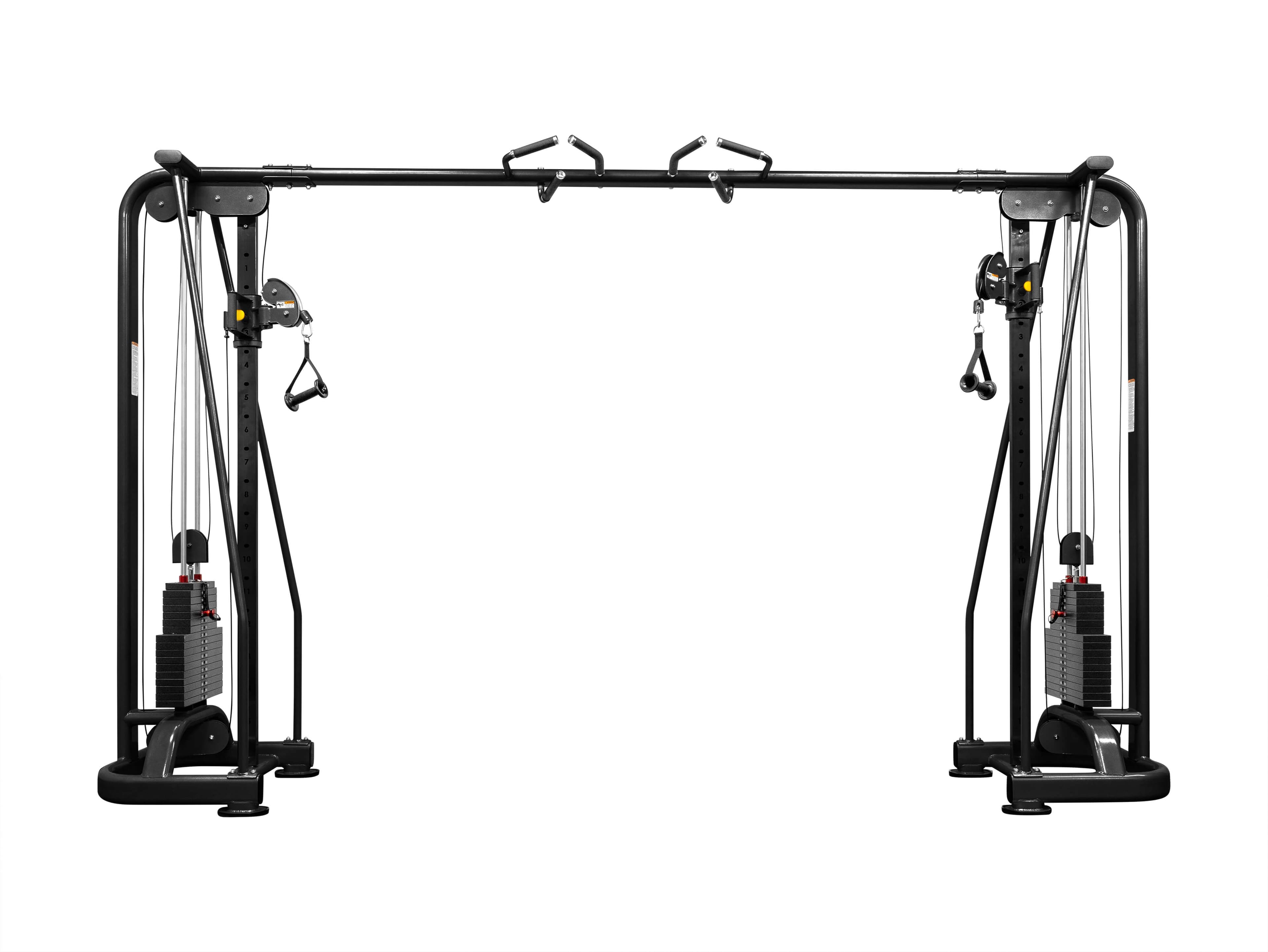
A cable machine is simpler than it looks. 3 controls cover almost everything in this plan, and learning them takes about 5 minutes.
Pulley height: the arm slides up and down and locks in place. Low for squats and curls, chest height for presses and rows, high for pulldowns and pushdowns.
Attachment: clip on the handle you need, whether a rope for triceps and core or a bar for pulldowns and rows. Single handles cover one-arm work.
Weight: set the pin in the stack. Start light enough that the last 2 to 3 reps feel hard while your form stays clean, then adjust from there.
Position yourself so the cable pulls in a straight line against the working muscle, and move with control in both directions, knees softly bent and core braced. The lowering half of each rep counts as much as the lift, so resist the weight on the way back rather than letting it snap the stack down.
The Full-Body Cable Workout
This is the single session you repeat 3 times a week. The exercises run from the largest muscle groups down to the smallest, which is how you get the most from your energy. Work through them in order and rest as your current phase prescribes, keeping your technique tidy on every rep. If your gym is missing a station, the substitution note below keeps you on track.
# | Exercise | Pulley | Trains |
1 | Cable squat | Low | Quads, glutes, core |
2 | Cable Romanian deadlift | Low | Hamstrings, glutes, lower back |
3 | Cable chest press | Chest height | Chest, shoulders, triceps |
4 | Lat pulldown | High | Back, biceps |
5 | Cable shoulder press | Low to high | Shoulders, triceps |
6 | Seated cable row | Chest height | Mid-back, biceps |
7 | Cable Pallof press | Chest height | Core, obliques |
8 | Cable curl and triceps pushdown | Low / high | Biceps, triceps |
Substitutions: no seated row station means a standing single-arm cable row works fine, and no shoulder-press setup means a cable lateral raise covers the shoulders. The arm work in slot 8 is an optional finisher to add once the main movements feel comfortable.
How to perform each movement
Cable squat: set a low pulley with a rope, hold it at your chest, and stand back so the cable is taut. Sit your hips down and back until your thighs reach near parallel, chest up and heels down, then drive up. The cable helps you balance, which makes this a forgiving way to learn the squat pattern.
Cable Romanian deadlift: from a low pulley, hold the handle at your thighs, soften your knees, and push your hips back while your back stays flat. Lower until your hamstrings feel a stretch, then squeeze your glutes to stand tall. Focus on pushing the hips back rather than bending forward.
Cable chest press: with a handle in each hand and a staggered stance for balance, press straight forward until your arms are nearly extended. Return slowly until you feel a gentle stretch across the chest.
Lat pulldown: sit with your thighs under the pads and grip the bar a little wider than your shoulders. Pull it to your upper chest by driving your elbows down and squeezing your back, then control the bar back up rather than letting it yank your arms straight.
Cable shoulder press: using single handles, press from shoulder height to overhead without arching your lower back. If overhead pressing feels awkward early on, a cable lateral raise builds the same muscles with less fuss.
Seated cable row: sit tall with a slight knee bend and pull the handle to your stomach, leading with the elbows and squeezing your shoulder blades together. Keep your torso still rather than rocking back and forth.
Cable Pallof press: set a chest-height pulley and stand side-on, holding the handle at your chest with both hands. Press it straight out and resist the twist the cable creates. This trains the deep core muscles that support your spine.
Cable curl and triceps pushdown: for curls, use a low pulley and curl toward your shoulders without swinging. For pushdowns, switch to a high pulley and straighten your arms down with your elbows pinned to your sides. Treat both as an optional finisher.
The 8-Week Progression Plan
Progress comes from doing a little more over time while the workout itself stays the same. You keep the same 8 exercises across all 8 weeks and let the difficulty climb in 4 phases. Repeating the movements is the point: it is how you get better at them and how your muscles get the steady, rising challenge that drives growth.
Phase | Weeks | Sets x reps | Focus |
1. Foundation | 1-2 | 2 x 12-15 | Learn the movements, keep it light, 2-3 reps in reserve |
2. Build | 3-4 | 3 x 12-15 | Add a third set, raise reps week to week |
3. Progress | 5-6 | 3 x 10-12 | Add resistance, slightly heavier loads, 2 reps in reserve |
4. Challenge | 7-8 | 3 x 8-12* | Train with real intensity, 1-2 reps in reserve |
*In phase 4, use the lower 8 to 12 range on the 5 main movements (squat, deadlift, chest press, pulldown, row) and hold 12 to 15 reps on the shoulder press and Pallof press, plus the arm finisher. Rest about 60 to 90 seconds between sets early on, stretching to 90 to 120 seconds on the main lifts once the loads climb.
How each phase works
Weeks 1 to 2, foundation: your only job is to learn each movement and finish every set with 2 to 3 reps in reserve. Pick a weight that feels almost too easy. 2 sets is plenty while your body adapts and your technique sharpens.
Weeks 3 to 4, build the base: add a third set to every exercise and start nudging the reps up, aiming for a rep or two more each week at the same weight. More good-quality work is the main driver of early progress.
Weeks 5 to 6, add resistance: drop into a slightly lower rep range and add weight where your form allows, leaving about 2 reps in reserve. You are training with intent now, well past the learning stage.
Weeks 7 to 8, raise the intensity: push the main lifts into the 8 to 12 range and work to within 1 to 2 reps of a hard but clean finish, adding a fourth set on a lift or two if you feel strong. Feeling run-down? Take a lighter week, halve the sets, and ease the loads. Recovery is built into the plan.
How to Add Resistance Without Stalling
The simplest reliable method for a beginner is double progression. You work inside a rep range and add reps first, then weight. Take the cable chest press with a 12 to 15 target. Week one might give you 12 on the first 2 sets and 11 on the last. Each session, try to add a rep or two until you reach 15 on every set, then raise the weight by the smallest stack increment and drop back toward 12 before climbing again.
A couple of rules keep this safe. Change one variable at a time, usually reps or weight, so you always know what drove the result. And skip training to failure, because stopping with 1 to 3 reps in reserve builds strength while protecting your form and your joints. Reps and load are equally valid routes to progress, and the research agrees. A 2022 study followed beginners for 8 weeks and found that adding reps and adding load produced almost identical muscle growth, around 7% either way. Keep a log in a notebook or an app, because adding a little each week only works if you remember what you did last time.
Warm-Up and Cool-Down
Give 5 minutes to raising your body temperature before you touch the stack: a brisk walk or an easy cycle, then a few arm circles and bodyweight squats. Finish with one light set of your first exercise. Warming the muscles and joints this way makes the working sets feel smoother and lowers your injury risk.
Afterward, spend another 5 minutes winding down. Walk until your breathing settles, then ease into a few gentle stretches for the muscles you trained, holding each one without bouncing. A short cool-down supports the recovery that your next session depends on.
Form and Recovery Fundamentals
Technique comes before weight, every time. Move through the full range of each exercise, control the lowering phase rather than dropping the stack, breathe out as you exert, and keep your core braced to protect your spine. The most common beginner mistakes are loading too heavy and rushing the reps with swinging, sloppy form. Slow down and lighten up, and the results arrive faster.
Recovery is when the body gets stronger, so the rest days between sessions count as part of the program. Aim for solid sleep most nights, since that is when muscle repairs. Back the training with a balanced diet that has enough protein to rebuild tissue, and drink water through the day. Some muscle soreness in the first weeks is normal; sharp joint pain is not, and it is your signal to back off and check your form.
Putting It All Together
You now have a complete plan to follow, start to finish. Train the full-body cable workout 3 times a week, move through the 4 phases in order, add reps before weight, and respect the warm-ups and rest days that make the work pay off. The cable machine gives you the most forgiving way to learn, and the 8-week structure turns that learning into measurable strength.
The biggest factor in your results is consistency: showing up for all 8 weeks. Do that, and you finish with a stronger body and confident technique, plus a foundation you can build on for years, whether you stay with cables or move into free weights next.
Frequently Asked Questions
Can you build muscle with just a cable machine?
Yes. Cable machines deliver constant tension and adjustable resistance, which is what muscles need to grow, and a single station trains every major muscle group. As long as you add reps and weight over time, a cable-only plan builds real strength and size, especially for a beginner.
How many days a week should a beginner train?
Train 3 days a week on a full-body routine, with a rest day between sessions. That pattern suits beginners well, hitting each muscle group often enough to drive progress while leaving time to recover and adapt. Space the sessions across the week so no two land back to back.
How much weight should I start with on cables?
Start light enough that the final 2 to 3 reps of each set feel hard while your form stays clean. For most beginners that is lighter than expected. Going too light and adding weight as you improve beats going too heavy and risking injury or sloppy technique.
How long until I see results?
Most beginners feel better strength and coordination within 2 to 4 weeks, with visible changes in muscle tone over the full 8 weeks, provided they train consistently and recover well. Strength gains show up first, because your nervous system adapts before your muscles visibly change.
Should I train to failure?
No, especially as a beginner. Stop each set with 1 to 3 reps in reserve, meaning you could manage a few more with good form. This builds strength while protecting your technique and joints, and it leaves you fresh enough to finish the workout and recover for the next one.
What comes after the 8 weeks?
A few good options open up. Repeat the plan with heavier weights and lower reps, or add a fourth day and split the body into upper and lower sessions. You could also start folding in free-weight versions of these movements, now that your technique is solid. Whatever you pick, the base you built transfers directly.
Trending Now
25 Best Functional Trainer Exercises for a Full-Body Workout
Functional Trainer Leg Exercises: The Complete Guide
Newsletter
Enter your email and be the first to get the latest blog posts, news, product launches and more from BodyKore.
Stay in the Know
Enter your email and be the first to get the latest blog posts, news, product launches and more from BodyKore.