The Quick Rundown
Great for legs, with limits: a functional trainer excels at single-leg work along with glute and hamstring training, but it cannot load heavy bilateral squats like a barbell.
Constant tension: the cables keep your leg muscles under load through the whole range, which builds muscle and spares the joints.
The counterbalance advantage: holding a cable in front of you lets you sit upright into a deep squat with far less strain on the lower back.
Best uses: lunges, split squats, Romanian deadlifts, pull-throughs, and glute work are where cables excel for the lower body.
How to program it: use cables for unilateral and isolation work, and pair them with free weights when maximal leg strength is the goal.
Most people think of the functional trainer as an upper-body machine, reaching for it to train the upper body while heading to the squat rack for legs. That sells it short. With its adjustable cables and constant tension, a functional trainer can build strong, balanced legs, and it does some jobs, like single-leg and glute work, better than a barbell can.
The honest catch is that a functional trainer is not the tool for your heaviest squats and deadlifts, since the weight stack cannot load your legs the way a loaded barbell or leg press can. What it does well is everything else: unilateral exercises that fix imbalances, glute and hamstring isolation, joint-friendly resistance for rehab and high-rep work, and a cable counterbalance that helps your form. This guide covers the best functional trainer leg exercises, organized by movement pattern, with how-to steps and a sample workout, plus tips to get the most from your cable leg days.
Why Train Legs on a Functional Trainer?
Cables bring a few real advantages to leg training that free weights cannot match, even if they give up the top-end loading. Understanding these strengths is what lets you use the machine where it helps rather than forcing it to replace the barbell.
The first benefit is constant tension. Where a dumbbell only loads your legs at certain points in a movement, a cable keeps resistance on the muscle through the entire range, which is excellent for building the glutes and hamstrings and keeping high-rep sets productive. The second is the cable's role as a counterbalance. Holding a cable at chest height lets the machine pull you forward slightly, so you can sit straight down into a deep squat or lunge while keeping your torso upright, which reduces strain on the lower back and helps beginners learn good positions.
Cables are also made for unilateral work. Single-leg exercises like lunges and split squats are easy to load and control on a functional trainer, and training one leg at a time exposes and corrects the side-to-side imbalances that bilateral lifts hide. The smooth resistance is gentle on the joints, which suits rehab and longevity-focused training, and the visible cable path even helps you learn a clean hip hinge. The trade-off is honest: for your heaviest, lowest-rep strength work, a barbell still wins, so a common approach is to do most of your heavy leg training with free weights and use the functional trainer for the unilateral and glute work it does best.
Squat and Lunge Exercises
These quad-focused movements build the fronts of your thighs along with the glutes, and the cable's counterbalance makes many of them more comfortable than their free-weight versions.
Cable Squat: works the quads and glutes, along with the hamstrings, under constant tension. Attach a straight bar or a V-handle to the low pulley and hold it at chest height facing the machine, then sit down into a deep squat and drive up through your heels. The cable pulls you forward just enough to keep your chest up and your spine in a safer position than a barbell back squat. Keep your knees tracking over your toes.
Cable Goblet Squat: a squat variation that challenges the core and reinforces an upright torso. Hold a rope or a V-handle at chest height and step back a few feet so the cable pulls you forward, then squat down while resisting that forward pull. Standing further back increases the demand on your core and upper back.
Cable Reverse Lunge: a beginner-friendly single-leg builder for the quads and glutes, with a core demand. Hold a single handle at chest height and step one foot straight back into a lunge, lowering your back knee toward the floor, then drive through the front heel to return. Holding the cable in the hand opposite your working leg adds an anti-rotation challenge for the core.
Cable Forward Lunge: a classic lunge with the bonus of cable resistance and a stability demand. Hold the cable at chest height, step forward into a lunge while keeping your torso upright and your front knee in line with your toes, then push back to the start. Complete all your reps on one leg before switching sides.
Cable Lateral Lunge: a side-to-side movement that trains the inner and outer thighs along with the glutes that forward movements miss. Hold the cable at chest height and step out to the side into a deep lunge, keeping your stationary leg straight, then push back to center. It is a great way to train the frontal plane that most leg routines neglect.
Bulgarian Split Squat: a demanding unilateral exercise for the quads and glutes that also builds balance. Attach a single handle at a low setting and rest your rear foot on a bench or a box, then lower into a split squat before pushing through your front heel to rise. The raised rear foot increases the range of motion, while front-loading the cable reduces the load on your spine.
Cable Step-Up: a simple, athletic move for the quads and glutes that mimics climbing. Hold the cable for resistance and step up onto a sturdy box leading with one foot, then stand tall and lower under control. Keep the movement driven by the working leg rather than pushing off the trailing foot.
Also Read: Functional Trainer vs Cable Crossover Machine: Which Should You Buy?
Hip Hinge Exercises
Hinge movements target the posterior chain, the glutes and hamstrings along with the lower back, and this is where the cable's tension and visible pulling path are a genuine advantage.
Cable Romanian Deadlift: one of the best cable moves for the hamstrings and glutes, built around a clean hip hinge. Hold a rope or handles from the low pulley and stand a few feet back. Hinge at the hips with a slight knee bend and a flat back until you feel a strong stretch in your hamstrings, then squeeze your glutes to stand. The constant cable tension makes the stretch especially effective, and the pulling path helps beginners learn the hinge. Aim for roughly 8 to 12 reps for muscle growth.
Cable Pull-Through: a glute and hamstring exercise that teaches explosive hip extension. Face away from the low pulley with the rope between your legs and walk forward to create tension, then hinge at the hips and let the rope travel back before snapping your hips forward and squeezing your glutes hard at the top. Keep the movement at your hips rather than rounding your lower back.
Cable Deadlift: a hybrid of a squat and a deadlift that loads the whole posterior chain. With a handle in each hand at your sides, similar to a trap-bar deadlift, hinge and bend to lower your hips while keeping your back flat, then drive up to stand tall. It works the hamstrings and glutes, plus the quads, while bracing the core.
Single-Leg Cable Deadlift: a balance and posterior-chain challenge that builds stability along with strength. Standing on one leg holding the cable, hinge forward at the hip while extending the free leg behind you, then return to standing under control. Move slowly and focus on staying balanced before adding much weight.
Glute and Hip Isolation Exercises
When you want to target the glutes and the smaller hip muscles directly, an ankle strap turns the functional trainer into one of the best glute machines available, all without loading your spine.
Cable Glute Kickback: a direct glute isolation move, sometimes called the donkey kick. Attach an ankle strap to the low pulley and lean forward holding the frame for support, then drive one leg back and up in a controlled arc with a slight bend in the knee, squeezing the glute at the top. Because nothing loads your spine, it is a joint-friendly way to overload the glutes.
Cable Hip Abduction: an exercise for the gluteus medius and minimus that carries over to athletic movement. Attach the ankle strap below knee height and stand side-on to the machine with the strap on the outer leg, then hold on for balance and lift that leg out to the side under control. Strong hip abductors improve stability and help with cutting and lateral sports.
Cable Hip Adduction: the counterpart to abduction, training the inner-thigh adductors that most leg routines ignore. With the ankle strap on the inner leg and standing side-on, pull your working leg across and in front of your body against the cable, then return slowly. It strengthens the often-neglected adductors that stabilize the hips and knees.
Best Exercise by Goal
If you are not sure where to start, the table below points you to the strongest functional trainer leg exercise for a few common goals.
Goal | Best functional trainer exercise |
Build the glutes | Cable pull-through and glute kickback |
Grow the hamstrings | Cable Romanian deadlift |
Quad development | Cable squat and Bulgarian split squat |
Fix side-to-side imbalances | Reverse lunge and single-leg deadlift |
Beginner-friendly and joint-safe | Cable squat and cable reverse lunge |
Athletic and lateral strength | Lateral lunge and hip abduction |
A Sample Functional Trainer Leg Workout
This session combines a squat, a hinge, single-leg work, and glute isolation for a complete lower-body workout on the cable machine alone. Rest about 90 seconds to 2 minutes between sets, and choose a weight that makes the last couple of reps challenging while keeping your form clean.
Exercise | Sets and reps |
Cable squat | 3 sets x 10-12 |
Cable Romanian deadlift | 3 sets x 10-12 |
Cable reverse lunge | 3 sets x 10 each leg |
Bulgarian split squat | 3 sets x 10 each leg |
Cable pull-through | 3 sets x 12-15 |
Cable glute kickback | 2 sets x 15 each leg |
Tips for Better Cable Leg Training
A few habits make these functional trainer exercises far more effective. Control every rep and never let the stack crash down, because the constant tension that makes cables useful disappears the moment you start swinging the weight. Use a full range of motion, sitting into a deep squat or feeling a complete hamstring stretch on hinges, since that is where the growth happens.
Brace your core on every movement to protect your spine and keep your torso stable, and on single-leg exercises, finish all your reps on one side before switching so each leg works independently. Keep your knees tracking in line with your toes on squats and lunges to protect the joints. Finally, apply progressive overload by adding weight or reps over time, and remember that for your heaviest leg training you can still lean on free weights, using the functional trainer for the unilateral and glute work it does best. If you are recovering from an injury, check with a physical therapist or a doctor before loading these patterns.
Putting It All Together
A functional trainer is more capable on leg day than most people give it credit for. It will not replace heavy barbell squats for raw strength, but it offers a deep library of squat, lunge, hinge, and glute exercises that build muscle and improve balance while protecting your joints through constant tension. For single-leg work and glute and hamstring training, plus joint-friendly volume, it is one of the most useful machines you can train your lower body on.
Build your leg sessions around a squat, a hinge, a single-leg movement, and some glute isolation. Keep your reps controlled and your range full, and progress the load over time. Used this way, the functional trainer becomes a complete lower-body tool, whether it handles your whole leg day or complements the heavy lifting you do with free weights.
Frequently Asked Questions
Can you build legs on a functional trainer?
Yes, though with a caveat. A functional trainer builds muscle in the quads and glutes, plus the hamstrings, through constant tension, and it excels at single-leg and glute work. The one limit is maximal strength: because the weight stack cannot load you as heavily as a barbell, serious powerlifting-style leg strength still calls for free weights. For muscle growth and balance, plus joint-friendly training, the functional trainer is highly effective on its own.
What is the best cable leg exercise for glutes?
The cable pull-through is hard to beat for the glutes, because it trains powerful hip extension with constant tension and lets you squeeze hard at the top. The cable glute kickback is a close second for direct isolation, since it overloads the glute without any load on your spine. Romanian deadlifts and reverse lunges also build the glutes well, so a mix of a hinge and an isolation move covers them thoroughly.
Are functional trainer leg workouts heavy enough to build muscle?
For most people, yes. Muscle growth comes from sufficient tension and effort close to failure, along with progressive overload, all of which a functional trainer provides, especially on single-leg and isolation exercises where you do not need enormous loads. Very strong lifters may find the stack limiting for bilateral squats, which is exactly why cables pair so well with free weights, handling the unilateral and accessory work while the barbell handles the heaviest lifts.
How often should I train legs on a functional trainer?
Training legs 2 to 3 times a week is a solid target for most people, whether you use the functional trainer alone or alongside free weights. Leave at least a day of recovery between hard leg sessions so the muscles can rebuild. As with any program, consistency and gradual progression matter more than any single workout.
Cable squats or barbell squats, which is better?
They serve different purposes. Barbell squats allow far heavier loading and are the better choice for maximal strength and overall mass. Cable squats keep constant tension and reduce strain on the lower back thanks to the counterbalance. They are also easier on the joints and friendlier for beginners learning the movement. The best approach uses both, with barbell squats for heavy strength and cable squats for volume and joint-friendly form practice.
What attachments do I need for cable leg exercises?
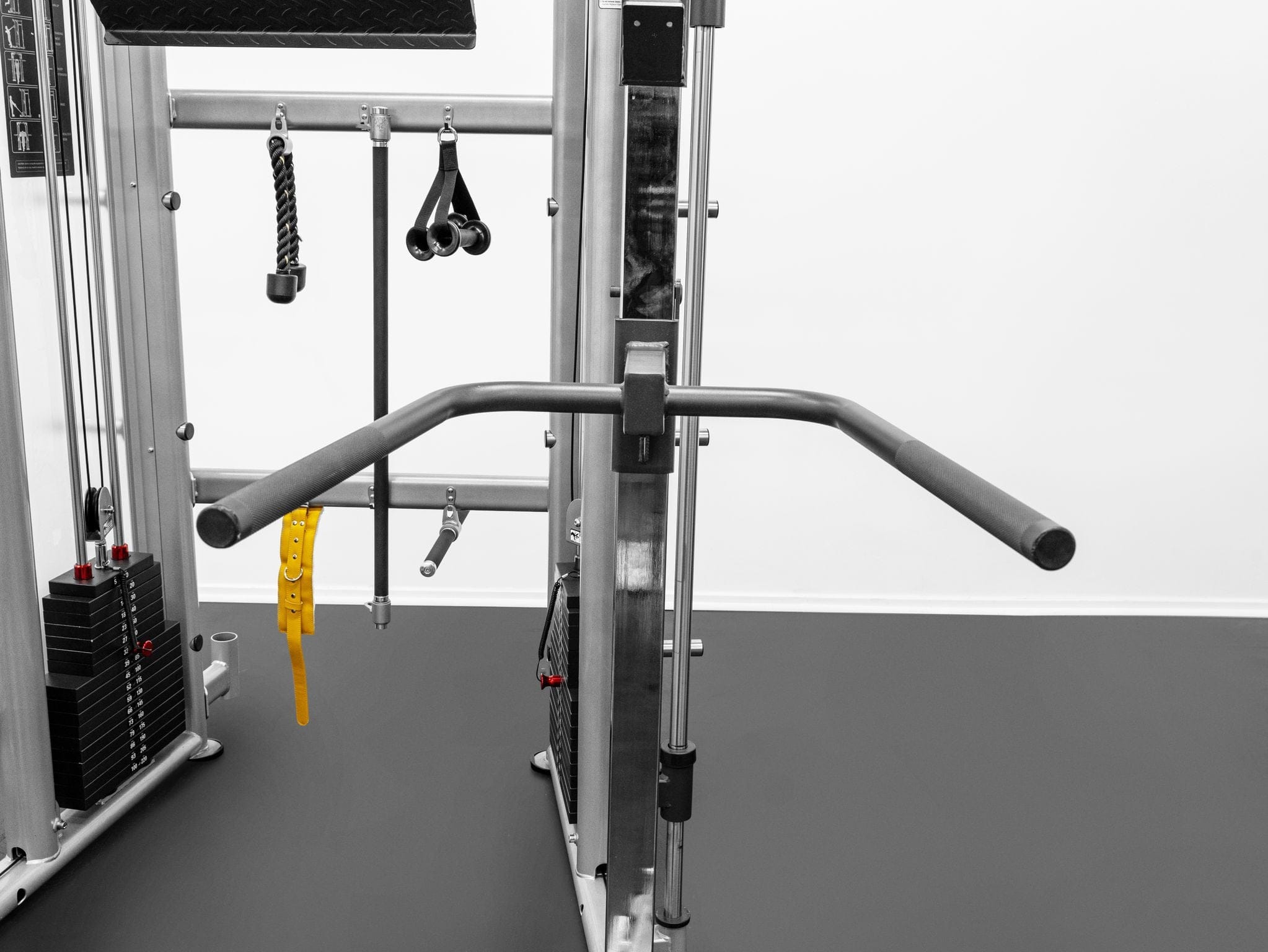
Three attachments cover almost everything. An ankle strap is the key piece for glute kickbacks and hip abduction or adduction; a rope or a straight bar handles squats and Romanian deadlifts, plus pull-throughs; and a single handle is ideal for lunges and split squats. A bench or a sturdy box also helps for split squats and step-ups. Most functional trainers include these basics in their starter set.
Also Read: Functional Trainer vs Smith Machine: Which Is Right for Your Gym?
Trending Now
25 Best Functional Trainer Exercises for a Full-Body Workout
Beginner Cable Machine Workout Plan: 8 Weeks
Newsletter
Enter your email and be the first to get the latest blog posts, news, product launches and more from BodyKore.
Stay in the Know
Enter your email and be the first to get the latest blog posts, news, product launches and more from BodyKore.