The Quick Rundown
Demand is the baseline: roughly 70% of travelers say they will pay more for a hotel with a gym, and fitness ranks among the most-applied filters on the major booking platforms.
A gym earns its keep: strong wellness amenities can add 10-15% to average daily rate, which converts low-value floor area into profit.
Hotel gyms differ from commercial gyms: with no staff on the floor and guest rooms close by, quiet, guided-motion equipment that is safe to use alone beats a complex free-weight setup.
Budget by the square foot: plan roughly $50-$75 per square foot for equipment, then cost flooring, mirrors, screens, and installation on top.
Match the tier to traffic: light commercial suits low-traffic boutique properties, whereas busy and branded hotels need full commercial machines built for long daily duty cycles.
Accessibility is mandatory: design for a 30-inch by 48-inch clear floor space at accessible equipment and 36-inch routes, alongside egress and signage and a posted emergency plan.
Treat noise as part of the spec: when the gym sits above or beside occupied rooms, quiet machines and the right flooring prevent the reviews that quietly cost you bookings.
Plan for strength and recovery: in 2026, functional trainers and free weights matter as much as the cardio bank, and a recovery zone is now expected.
The right gym equipment for hotels used to be an afterthought, picked from whatever fit in a spare room. That era is over. A fitness room now decides whether a traveler even sees your property when they filter Booking.com, and it sits inside the brand standards that franchise auditors check. Most articles on the subject still hand you the same recycled list of cardio machines and a dumbbell rack, with nothing on how your property size, guest mix, square footage, noise limits, or compliance duties should reshape the whole plan.
This guide takes the harder, more useful angle. It treats your fitness center as the operating asset it has become. You get equipment recommendations scaled to your hotel size, honest budget ranges, the lifetime-cost math that separates light commercial machines from full commercial ones, the accessibility and safety rules almost every rival article ignores, plus the acoustic detail that keeps a 6 a.m. workout from turning into a 6:05 a.m. complaint. Read it through and you can specify a room that clears a brand audit, limits your liability, and pays back its floor space many times over.
Why a Hotel Gym Is No Longer Optional
A fitness room was a differentiator for years. Today its absence is a measurable handicap, and reframing why changes the entire purchase. You are not buying machines. You are buying search visibility, a rate premium, brand compliance, and repeat stays, so the spend should be judged on those returns rather than on the equipment alone.
Guest demand sets the floor
Health-conscious travel went mainstream a while ago. Surveys keep landing on the same figure: around 70% of travelers would pay extra to stay somewhere with a gym, and most say they would rather work out in the hotel than hunt for an outside option mid-trip. For the business traveler logging a hundred-plus nights a year, a dependable gym is a requirement, full stop.
That demand shows up in distribution. On the major booking platforms, fitness ranks among the most-used amenity filters, so a property without a gym can vanish from a guest’s results before the photos ever load. The lost revenue never appears on a report, which is exactly why owners keep underestimating it.
Dead space becomes a revenue asset
Almost every hotel carries floor area that earns little: a basement storeroom, an awkward ground-floor pocket that converts poorly into guest rooms. A fitness room is one of the cheapest ways to put that space to work. There is no commercial kitchen to build, no broadcast-grade audiovisual rig, and no service payroll of the kind a restaurant demands.
The payback is lopsided in your favor. A modest 300-square-foot room fitted with $15,000 to $25,000 of equipment can lift satisfaction scores and platform rankings, and bring more guests back. Analysts have tied strong wellness amenities to a 10-15% premium on average daily rate (ADR). Run the math on a 100-room property at 70% occupancy and even a $10 nightly bump adds north of $250,000 a year, a figure that swallows the equipment cost inside the first 12 months.
Brand standards can make it mandatory
Operate a franchised property and the choice may already be made for you. Major flags such as Marriott and Hilton write fitness facilities into their brand standards, and franchisees who fall short risk a failed audit. The real question becomes how to build a gym that clears inspection while delivering genuine value, rather than scraping the minimum and hoping nobody notices.
Loyalty and ancillary revenue follow
Guests who train during a stay tend to rate the whole property higher, gym included. Give them a clean, well-equipped room and it becomes a reason to rebook, pushing your hotel up the shortlist every time they return to your city.
Bigger facilities can also earn beyond the room rate. Hotels partner with local certified trainers and take a commission on guest sessions with zero payroll. They run dawn yoga or interval-training classes as paid add-ons. Some rent shoes and apparel for a few dollars to guests who forgot their gear, and city hotels sell off-peak memberships to nearby residents, which monetizes the space during the slow daytime hours.
How Hotel Gyms Differ From Commercial Gyms
The priciest mistake in this category is treating a hotel fitness room like a commercial gym. They share equipment names and not much else. Six differences should shape every line on your purchase order, and most of them push you away from the equipment a public gym would buy.
User diversity is extreme
Members of a commercial gym selected themselves; they joined because they want to train. Your hotel gym serves whoever checked in that night. The marathoner keeping a streak alive shares the room with the executive who last exercised in spring and the older leisure traveler trying a treadmill for the first time. Equipment has to welcome a beginner and still satisfy a seasoned lifter, which is a strong vote for intuitive, guided-motion machines.
Nobody is working the floor
Most hotel gyms run unsupervised, often around the clock. No trainer demonstrates a movement, and no spotter stands by for a heavy set. So every machine has to explain itself, stay safe for a solo user, and forgive sloppy form. That single fact is the best argument for selectorized and functional-trainer strength equipment over a loose barbell-and-bench arrangement that invites injury once the staff go home.
Noise turns into a complaint
A dropped weight is background noise in a commercial gym. In a hotel it reads as a one-star review the next morning. The fitness room often sits directly above, below, or beside paying guests, so low vibration and a quiet drive system stop being luxuries and become primary selection criteria.
Aesthetics carry your brand
Industrial flooring and exposed steel pass in a commercial gym. A hotel gym speaks for your design language, so the equipment should look clean and current, with finishes that match across cardio and strength. A room assembled from mismatched parts reads as neglect, and guests notice.
Generalists handle the maintenance
Dedicated technicians service commercial gyms. Hotels lean on engineering staff who also chase down plumbing and HVAC faults, so low-maintenance, modular equipment that a generalist can fix without special tools wins. Standardizing on coordinated product lines pays off here too, since it simplifies spare parts and future expansion at once.
Usage arrives in bursts
Traffic in a commercial gym stays fairly steady. Hotel traffic spikes hard, roughly from 6 to 8 a.m. and again from 5 to 7 p.m., then goes quiet for long stretches. Your mix has to soak up those peaks without a queue forming while still justifying its cost across the many idle hours in between.
How Much Space You Actually Need
A common industry benchmark puts roughly 350 square feet of fitness space behind every 200 guest rooms. Treat that as a starting point and nothing more. What you truly need depends on guest profile, star rating, and the equipment mix you are after. More than any single ratio, it comes down to giving each machine enough room around it for safe, comfortable movement.
As a planning guide, allow space per piece along these lines:
Equipment type | Footprint per piece (approx.) |
Cardio machines (treadmill, bike, elliptical, rower) | 10-30 sq ft |
Selectorized and strength machines | 20-50 sq ft |
Functional training and open floor (per person) | 20-30 sq ft |
Stretching and recovery zone | 125-250 sq ft total |
Circulation matters as much as footprints. Put the busiest equipment near the entrance so traffic does not cut across active machines, group equipment into logical zones, and keep walkways wide enough that nobody squeezes past a guest mid-set. A well-zoned 300-square-foot room consistently outperforms a cramped, badly planned 500-square-foot one, which is the single most common error I see in retrofits.
Right-sizing cardio against strength by property size
As a property scales up, the balance tilts away from cardio-heavy layouts toward more strength and functional space. That shift tracks both guest expectations and the wider 2026 move toward strength-first training.
Property size | Typical fitness footprint | Cardio to strength balance |
Small (under 100 rooms) | 200-400 sq ft | about 65 to 35 |
Mid-size (100-300 rooms) | 400-800 sq ft | about 55 to 45 |
Large or resort (300+ rooms) | 800+ sq ft | about 50 to 50, or strength-led |
Designing the Space for Flow and Guest Experience
A good hotel gym is not measured by how many machines you cram in. It is measured by flow. The same equipment, arranged well, reads as calm and premium; arranged badly, it reads as clutter that guests avoid. Three design layers turn an equipment list into an experience.
Zone the room and steer the traffic
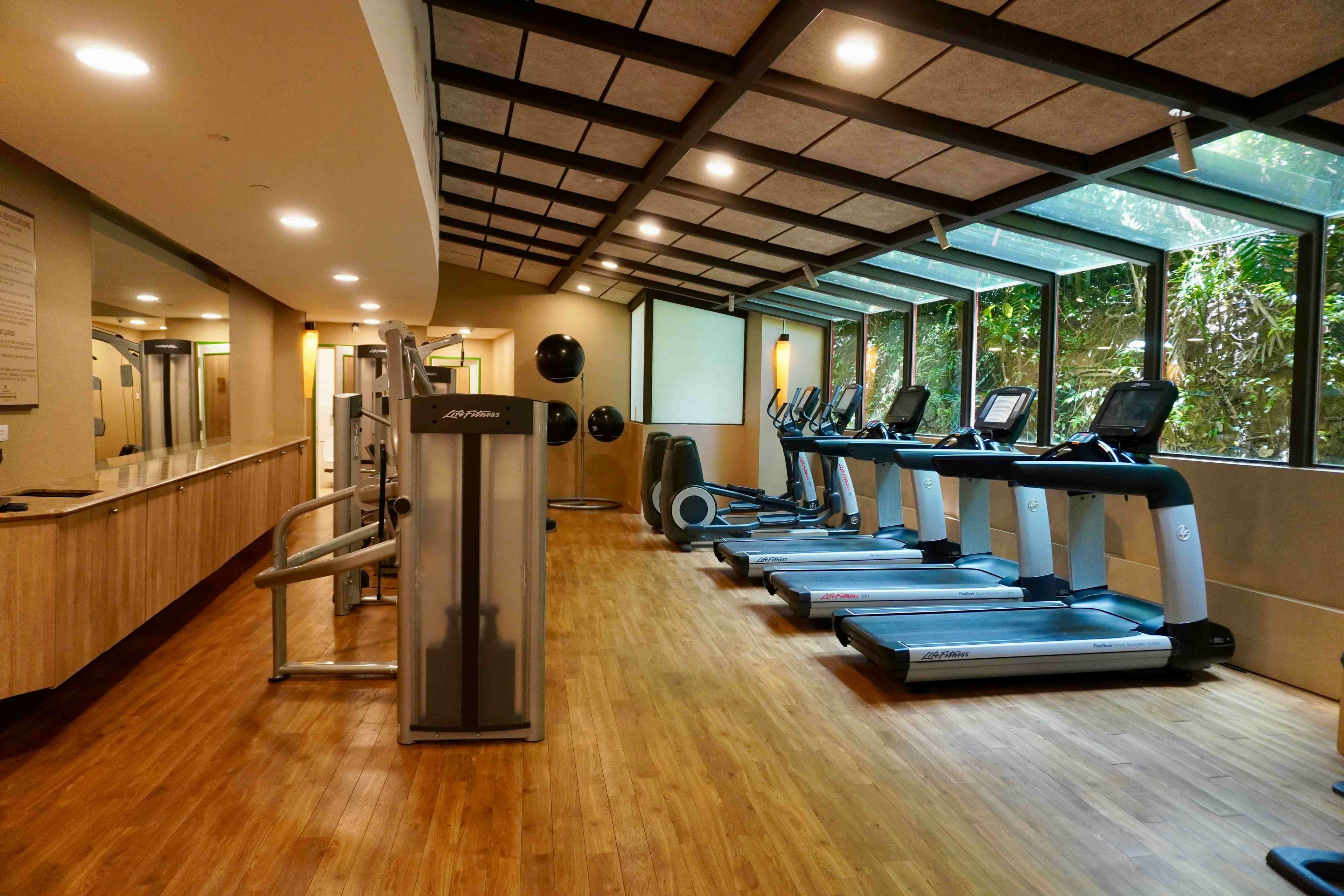
Group equipment into clear zones so a guest instantly knows where to go: cardio, strength, free weights, and a functional and stretching corner. Place the most-used pieces near the entrance where they stay visible and out of the through-path. From there, let the layout flow from warm-up to cardio to strength and finish at stretching, with walkways generous enough that nobody has to step over someone. Keep the louder, higher-impact gear together and toward the back, which keeps the front of the room inviting.
Let mirrors and light do the heavy work
Mirrors serve two jobs at once. They let guests check form, and they make a compact room feel far larger. Pair them with bright, even light, as much of it natural as the space allows, and with clear sightlines so the whole room registers at a glance. A small footprint, mirrored and well lit, comes across as premium; the same area in dim light with broken sightlines comes across as an afterthought. Where you can, run cardio along the wall with the best window light, since that is where guests linger longest.
Plan storage and the small touches
Tidy storage separates a maintained room from a chaotic one. Give every accessory a home: a rack for the dumbbells and bins for bands and mats, with a tower for the foam rollers. Add a sanitizing station with wipes, a water dispenser, and a towel supply if your service level stretches to it. These touches cost little and signal care, and in my experience a visibly clean, organized room drives more positive reviews than the brand of any single machine in it.
The Core Equipment Categories
Every hotel gym, large or small, is assembled from four categories. Once you understand the job each one does, and which pieces return the most guest value per square foot, you can scale the same blueprint up or down with confidence.
Cardio comes first
Cardio stays the foundation of any hotel fitness room because it asks nothing of the user and suits the widest range of guests. A frequent professional starting point is a 3:2:1 ratio of treadmills to ellipticals to bikes, which handles peak-hour demand without queues. Treadmills draw the most requests, so spend your reliability budget here and look for smooth belt tracking and an enclosed drive that keeps both noise and service calls down. Rowers and recumbent bikes round things out, and the recumbent in particular widens your appeal to older and rehabilitating guests.
Strength should be guided and space-efficient
Strength is where hotel logic matters most, and where the strength-first shift of 2026 shows up clearest. Because nobody is there to spot a lift or fix form, functional trainers and multi-station machines do most of the work in a hotel gym. One functional trainer with adjustable dual pulleys delivers dozens of guided, low-injury-risk exercises in the footprint of a single machine, which answers tight space and solo use in one purchase.
Selectorized machines, the kind with a pinned weight stack, suit beginners because the path is fixed and the load changes in seconds with no loose plates to rack. Mid-size and larger properties can extend that with a compact strength circuit or a multi-gym station, broadening the muscle groups covered while keeping everything self-explanatory. These guided, modular formats also sit well with the generalist-maintenance reality of most hotels.
Free weights deliver value in a tiny footprint
A dumbbell rack running from roughly 5 to 50 pounds, paired with one or two adjustable benches, opens up an enormous range of exercises and ranks among the best value-per-square-foot buys you can make. Guest preference leans hard toward free-weight and functional training these days, so even a small property should carry a compact dumbbell set. Fixed dumbbells, rather than plate-loaded barbells, cut both the noise and the loose-part risk that an unsupervised room cannot police.
Functional and recovery space is growing fast
A defined open area for functional and bodyweight work, stocked with a few kettlebells, resistance bands, a medicine ball, and yoga mats, costs little and meets a clear 2026 expectation. The recovery zone deserves equal attention, and it is the piece most hotel gyms forget. Foam rollers and stretching straps, set in a small mobility corner, measurably raise satisfaction scores. A quiet, mirrored flexibility area also lifts usage among female guests by a wide margin, which broadens the appeal of the whole room.
Equipment Recommendations by Hotel Size
The configurations below turn those categories into concrete starting lists, each with a realistic equipment-only budget. Read the budgets as planning references; the real number moves with equipment tier, brand, and whether you buy new or certified refurbished. Flooring, mirrors, screens, and installation are costed separately in the budgeting section.
Small hotel, under 100 rooms (200-400 sq ft)
The aim here is maximum coverage in minimum space. Lead with cardio, add one space-efficient strength solution, and keep the center of the room open for stretching and bodyweight work.
2 treadmills (commercial, or quality light-commercial)
1 elliptical or an upright or recumbent bike
1 functional trainer or compact multi-gym as the strength centerpiece
1 dumbbell set (5-50 lb) with a rack and one adjustable bench
Accessories: yoga mats, resistance bands, a foam roller, a sanitizing station
Typical equipment budget: $15,000 to $35,000.
Mid-size hotel, 100-300 rooms (400-800 sq ft)
With more room comes the chance to separate zones: cardio by the windows, a strength area against a mirrored wall, and a defined functional and stretching corner, with traffic flowing naturally between them.
3 treadmills, 2 ellipticals, 1-2 bikes, and an optional rower for the cardio bank
1 functional trainer plus a small selectorized circuit of 2-4 machines
Dumbbells (5-75 lb) with 2 adjustable benches
A defined functional zone: kettlebells, medicine balls, bands, and plyo space
A recovery corner: foam rollers, stretching straps, mats, and a mirror wall
Typical equipment budget: $30,000 to $75,000.
Large hotel or resort, 300+ rooms (800+ sq ft)
At this scale the room starts to resemble a small commercial gym, with independent zones and the headroom to lead with strength. Resort properties often add an outdoor training area or a dedicated group-fitness studio on top.
A full cardio bank: 4+ treadmills, multiple ellipticals, bikes, rowers, and a stair climber
Several functional trainers plus a fuller selectorized strength circuit
A comprehensive free-weight area: dumbbells to 100 lb, benches, and an optional rack
Dedicated functional-training turf or open zone
A distinct recovery and stretching area, with an optional sauna or other recovery amenity
Typical equipment budget: $75,000 to $200,000 and up.
Choosing Between Light and Full Commercial Equipment
One choice decides whether your gym runs smoothly or turns into a recurring repair ticket: the equipment tier. The right call is rarely the cheapest invoice. It is the lowest total cost of ownership (TCO) measured across the machine’s service life, once you fold in upkeep, downtime, and replacement.
Residential equipment has no business in a hotel. Home-grade machines were never built for the long daily duty cycles a busy hotel demands, and dropping them onto an unsupervised floor invites both breakdowns and liability. The genuine decision sits between light commercial and full commercial.
Factor | Light commercial | Full commercial |
Designed for | Low-to-moderate traffic (boutique, small properties) | Continuous daily use, high traffic, branded properties |
Construction | Lighter frames and lighter-duty motors | Heavier steel, commercial AC motors, advanced cushioning |
Upfront cost | Lower | Higher |
Warranty | Shorter | Longer, with stronger parts and labor terms |
Downtime risk | Higher under heavy use | Lower, since it is built for uptime |
Best fit | Under roughly 100 rooms, low peak demand | Mid-size and larger, brand-standard compliance |
A treadmill can run anywhere from roughly $2,500 to $12,000, with the spread driven by build tier and brand, and by the console you choose. The cheaper unit looks like a saving right up until you count faster wear, more frequent repairs, the downtime that frustrates guests, and an earlier replacement date. On a high-traffic floor, under-speccing usually costs more across the life of the machine than buying the right tier once. Judge every major purchase on lifecycle performance, which takes in maintenance, repair, energy draw, and downtime, rather than on the sticker price alone.
Budgeting and Financing Your Hotel Gym
Where construction stays limited, equipment is the largest line item. A workable planning figure is $50 to $75 per square foot of fitness floor space for equipment, with the spread driven by your cardio tier, whether consoles carry personal screens, and your strength selection. Budget the surrounding elements on their own:
Cost element | Typical range |
Rubber flooring | $3-$8 per sq ft |
Mirrors | $15-$30 per sq ft |
Televisions and screens | $300-$1,500 each |
Sound system | $1,000-$5,000 |
Signage and decor | $2,000-$10,000 |
Installation | $2,000-$15,000 |
Three tactics stretch the budget without dulling the result. Certified refurbished equipment from premium brands often sells at a steep discount to retail while holding near-new durability and warranty, which is a smart way to land elite cardio brands within a tighter cap. Financing or leasing preserves cash, with terms that commonly run 24 to 60 months, and leasing can carry tax advantages because the payments may be deductible. A phased rollout lets you open with the high-traffic pieces guests look for first and expand once the amenity has proven its return.
On taxes, Section 179 expensing and bonus depreciation can let you deduct a meaningful share of qualifying equipment, which trims the effective cost. The specifics ride on current law and your own situation, so confirm them with a tax advisor before you bank on any deduction.
Accessibility and Life-Safety Compliance
Accessibility is both a legal duty and a design discipline, and it is where generic equipment lists go silent. In the United States, places of public accommodation, hotels among them, have to make amenities like a fitness room accessible, and lawsuits under the Americans with Disabilities Act (ADA) have climbed sharply in recent years. Building compliance into the floor plan from day one costs a fraction of retrofitting it after a complaint lands.
Design around these core dimensions:
Clear floor space: keep a minimum 30-inch by 48-inch clear area at accessible equipment, and hold it between aisles, equipment, and furniture so a wheelchair user can approach and use the machines.
Accessible routes and doorways: provide a clear, unobstructed path into and through the room, with doorways offering at least a 32-inch clear opening, which usually means a 36-inch door.
Turning space: allow enough room for a wheelchair to maneuver, commonly a 60-inch turning diameter, inside the usable area.
Accessible equipment and seating: include equipment that guests with disabilities can use, and connect each piece with an accessible route.
Compliant signage: post permanent room signage that pairs raised characters with Braille, all in high-contrast lettering.
Life-safety codes run alongside the ADA. Keep emergency-egress paths clear at all times, check your maximum occupancy and ventilation against local fire code, and never let a machine block an exit. Because clearances and occupancy rules shift by jurisdiction, run your final layout past a local code authority or design professional rather than trusting national rules of thumb on their own.
Noise, Flooring, and Acoustics
When a gym sits above or beside guest rooms, treat acoustic control as part of the equipment spec from the very start. Two kinds of sound matter. Airborne noise covers motor hum along with any music or talk in the room. Structure-borne impact, the footfalls and dropped weights, travels through the building itself and lands in the rooms below.
Start with the floor, your single most effective move. A quality rubber gym floor, ideally laid over an isolation underlayment, absorbs impact and damps vibration; in free-weight areas, thicker tiles or platforms go where the loads are heaviest. After that, pick equipment that runs quietly by design, with balanced flywheels and enclosed, smooth-tracking drives, and favor fixed dumbbells and guided machines over plate-loaded barbells that practically beg to be dropped.
Layout backs up the flooring. Keep the noisiest equipment, the free weights and anything with impact, off the shared walls and toward the structurally quietest part of the room. If the floor plan allows, set the gym above a corridor, lobby, or back-of-house area rather than directly over a guest room. None of this costs much at the planning stage, yet it heads off the recurring complaints that erode review scores one star at a time.
Liability, Waivers, and the Unstaffed Gym
Most hotel gyms run without supervision around the clock, so risk management deserves the same care as equipment selection. No single document wipes out liability, but a layered approach cuts it down hard.
Equipment maintenance is the foundation of any defense. A faulty machine that injures a guest points straight back at upkeep, so regular inspection and prompt repair, both logged in writing, form the base of it, and that written record is often the strongest evidence you can put in front of a claim. Stack the other controls on top of it:
Insurance for unstaffed hours: confirm your liability policy explicitly covers 24-hour, unsupervised access, since many policies require it to be disclosed and added by endorsement.
Clear, current signage: post the hours, the rules, an instruction to use equipment at one’s own risk, plus wet-floor and proper-use warnings, and reference those operational measures in your risk documentation.
Access control: use key-card or room-key entry to limit the room to registered guests, which also creates a record of who came and went.
Emergency provisions: fit a clearly marked emergency phone or call button, post the emergency procedure, and consider an automated external defibrillator (AED) with staff trained to use it.
Waiver enforceability and the exact duties for unstaffed facilities vary by state, so have local counsel review your signage, any acknowledgment language, and how it all lines up with your insurance. Consistency is the goal: controls, documentation, and coverage that match how the gym actually runs.
The 2026 Trends Reshaping Hotel Fitness
What a hotel gym has to deliver keeps moving. Folding current expectations into the plan now keeps the investment from looking dated inside a year or two.
Strength moves to center stage
Strength training has become the top priority for gym-goers, with a large majority expecting more of it. For a hotel that means handing more space to free weights and functional or guided strength machines rather than defaulting to a wall of cardio.
Recovery shifts from optional to expected
Recovery now counts as part of training in its own right. At the affordable end, a stocked stretching and mobility zone meets the expectation cheaply. Larger and resort properties are adding saunas and other thermal or recovery amenities, which travelers increasingly seek out and which support premium pricing.
Connected and modular wins
Guests want equipment that syncs with their wearables and streams studio-style content, and operators want flexibility. Rather than simply building bigger, the sharper properties design multi-purpose, modular zones that flex through the day, which is a smarter use of space than raw square footage. A handful of in-room fitness options for premium room categories is an emerging differentiator at the high end.
How to Choose a Supplier
The supplier relationship outlives the sale, because the equipment will eventually need parts, service, and expansion. Weigh vendors on more than price:
Commercial-grade product and warranty: confirm the machines are rated for commercial use, then compare parts-and-labor warranty terms, which reveal how seriously the maker takes durability.
Parts availability and service network: ask how fast replacement parts ship and whether service reaches your region, since downtime on an unstaffed floor becomes a guest-experience problem fast.
Space planning support: the better suppliers offer floor-plan and zoning help, which pays off directly for ADA clearances and traffic flow.
Cohesive product lines: sourcing cardio and strength from coordinated lines simplifies parts and staff familiarity, and it keeps the room visually consistent.
Delivery and installation: clarify whether white-glove installation and removal of the old equipment are included, which matters most for upper-floor or basement rooms.
References and financing: request hospitality references, then weigh the financing and leasing terms, plus any trade-in, against your cash-flow plan.
Maintenance and Lifecycle Management
A hotel gym is only as good as its worst-kept machine. A treadmill with a torn belt and an out-of-service card does more reputational harm than simply owning one fewer treadmill. Build a plain, consistent program: a daily visual check and clean, plus scheduled preventive maintenance at the manufacturer’s intervals, all captured in a written log of every inspection and repair, which earns its keep for both uptime and, as noted, liability defense.
Plan for replacement while you are at it. Cardio equipment under heavy hotel use reaches the end of its dependable life sooner than strength equipment, which can soldier on for years on basic upkeep. Folding the expected replacement cycle into your capital plan keeps the room current and stops it from aging visibly until a costly full refresh becomes unavoidable. That is one more reason to get the tier and the product line right at the start, because standardized equipment stays cheaper to maintain and replace over time.
Putting It All Together
Specifying gym equipment for a hotel is a chain of connected decisions. Begin with the business case so the spend is sized to the return. Let property size and square footage set the cardio-to-strength balance and the clearances around each machine. Pick the tier on total cost of ownership rather than the invoice, and draw accessibility, acoustics, and risk management into the plan from the first sketch rather than bolting them on at the end.
Do that, and the fitness room stops being a box to tick and turns into one of the highest-return conversions in the building. It improves your booking visibility, supports a rate premium, satisfies brand standards, builds loyalty, and protects the business. The hotels that treat the gym as a strategic asset, and equip it that way, are the ones travelers filter for and come back to.
Frequently Asked Questions
How much does it cost to equip a hotel gym?
As an equipment-only planning figure, budget roughly $50 to $75 per square foot of fitness floor space. In practice that comes to about $15,000 to $35,000 for a small property, $30,000 to $75,000 for a mid-size hotel, and $75,000 to $200,000 or more for a large hotel or resort. Flooring, mirrors, screens, signage, and installation are budgeted on top.
How much space does a hotel gym need?
A common benchmark is about 350 square feet per 200 guest rooms, used as a starting point. Small hotels often work within 200-400 sq ft, mid-size properties within 400-800 sq ft, and large hotels or resorts within 800+ sq ft. Allow roughly 10-30 sq ft per cardio machine and 20-50 sq ft per strength machine, plus clear accessibility circulation.
What is the single most important piece of equipment?
The treadmill draws the most requests and anchors the cardio bank, so its reliability and quiet running are worth paying up for. On the strength side, a functional trainer delivers the most guided, safe-to-use-alone variety per square foot, which makes it the strength centerpiece for most hotel gyms.
Can I use home equipment to save money?
No. Residential machines were not built for the long daily duty cycles of a hotel gym, and they create real liability and downtime risk on an unsupervised floor. Use commercial-grade equipment, choosing light commercial for low-traffic boutique properties and full commercial for busy and brand-standard hotels.
Does a hotel gym have to be ADA compliant?
Yes. As a public accommodation, a hotel fitness room has to be accessible. Design for a minimum 30-inch by 48-inch clear floor space at accessible equipment, accessible routes and doorways with at least a 32-inch clear opening, adequate turning space, and compliant signage. Confirm the specifics with a local code authority, since requirements vary by jurisdiction.
How do I keep a hotel gym from disturbing guest rooms?
Combine quiet-by-design equipment, with enclosed drives, balanced flywheels, and fixed dumbbells in place of plate-loaded barbells, alongside a quality rubber floor over an isolation underlayment. Where the plan allows, set the gym above a corridor or back-of-house area rather than directly over a guest room, and keep the noisiest equipment off the shared walls.
Is certified refurbished equipment a good idea for a hotel?
It can be excellent value. Certified refurbished machines from premium brands often sell well below retail while holding near-new durability and warranty, which lets you put elite cardio brands on the floor inside a tighter budget. Buy from a reputable remanufacturer, confirm the warranty terms, and verify parts availability before you commit.
Should a hotel gym be staffed?
Most are not. The standard model is unstaffed and key-card-access, frequently 24-hour. That is exactly why equipment selection leans toward safe, guided-motion machines, and why insurance, signage, access control, and a documented maintenance log carry so much weight. Larger and resort properties may add staffed elements, such as a trainer on partnership or scheduled classes, as a revenue layer rather than for supervision.
Trending Now
25 Best Functional Trainer Exercises for a Full-Body Workout
Functional Trainer Leg Exercises: The Complete Guide
Beginner Cable Machine Workout Plan: 8 Weeks
Newsletter
Enter your email and be the first to get the latest blog posts, news, product launches and more from BodyKore.
Stay in the Know
Enter your email and be the first to get the latest blog posts, news, product launches and more from BodyKore.