
$3,599.00
Financing options...
Note: Limited Availability - Inquire to Order.
Most lifters train the posterior chain by accident. Deadlifts load the erector spinae. Romanian deadlifts stretch the hamstrings. Heavy rows brace the lumbar extensors under load. But none of those movements train spinal extension through a dedicated range of motion at an intensity the lower back muscles can actually adapt to over time.
The erector spinae group runs the full length of the spine in three columns: the spinalis closest to center, the longissimus lateral to that, plus the iliocostalis furthest out. Beneath those sit the multifidus muscles, short segmental stabilizers that attach vertebra to vertebra and are responsible for fine postural control. Research consistently shows that both multifidus cross-section and erector spinae size are measurably smaller in people with chronic lower back pain compared to those who've recovered from it. The pattern is consistent across studies: these muscles weaken when not specifically trained, and the weakness shows up first in the spine, not in the bigger lifts.
Dedicated lower back equipment addresses that gap by putting the posterior extensors under direct load through a full range of motion. Our lower back category covers adjustable hyperextension benches, selectorized back extension machines, and the ab/back combo station, so facilities can build a complete posterior chain section rather than leaving lower back work to compound lifting alone.
The lineup spans three product types. Each one delivers a different loading position for the lumbar extensors, the glutes, plus the hamstrings that work alongside them.
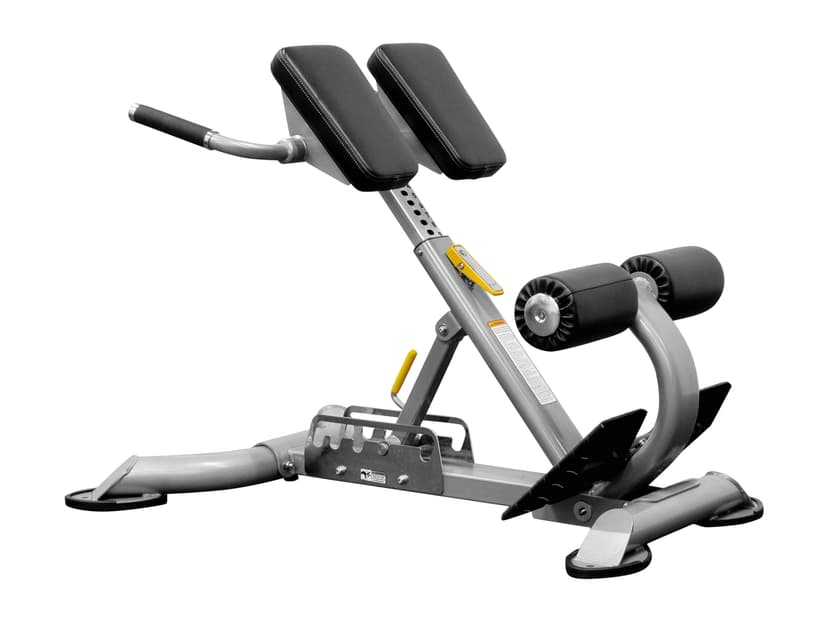
CF2104 Adjustable Hyperextension Roman Chair: The CF2104 is an adjustable Roman chair with 5 angle settings, a four-point base, and foam leg rollers that hold the user's position through the full movement arc. Five angles means a facility can shift from a 45-degree position (partial hip flexion, more glute emphasis) up to a near-horizontal Roman chair position (full spinal flexion range, maximum erector engagement) without changing equipment. The four-point base eliminates the rocking that occurs in lighter benches when a user loads the extension movement under bodyweight or added resistance. It's 1,000lb-rated and built for high-traffic commercial use.
GR612 Selectorized Back Extension: The GR612 is the selectorized back extension in the Isolation Series lineup, trained from a seated position with a pin-loaded stack. Seated back extension machines differ fundamentally from bench-based hyperextension: the hip stays fixed while the spine extends against resistance, which isolates the lumbar erectors more directly by removing glute and hamstring involvement. The pin-loaded format means weight changes without leaving the seat, making the GR612 the fastest-turnover lower back station for commercial facilities. The 220lb stack covers the working range for virtually all lower back training, since the erectors fatigue quickly relative to the legs.
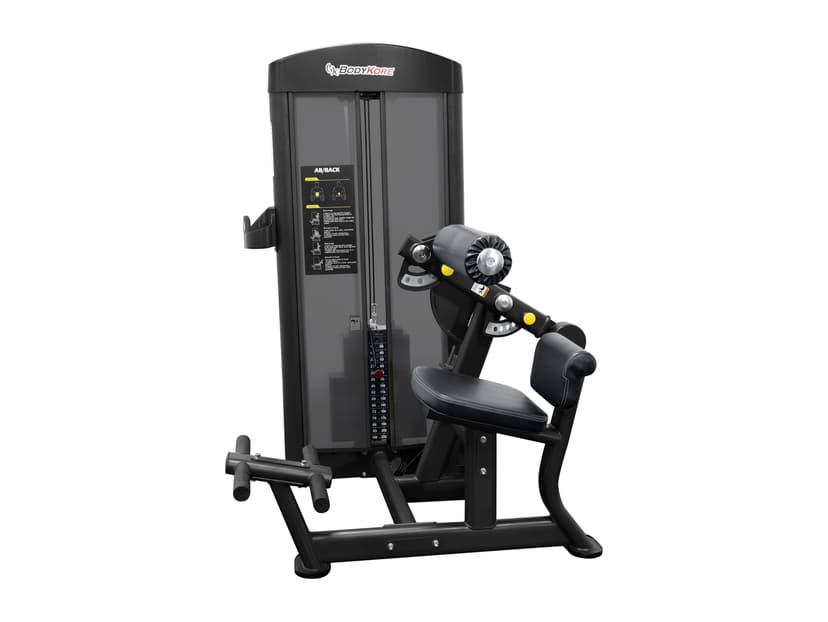
GR637 Abdominal and Back Extension Combo: The GR637 is a dual-station machine that trains the abdominal crunch on one side and back extension on the other. The lumbar pad positions correctly relative to the axis of rotation in both movement modes, and range-of-motion adjustment runs in 10-degree increments. For facilities managing floor space, this is the most efficient way to cover both anterior and posterior core without two separate stations. A lumbar pad that self-aligns at the hip crease is the detail that separates well-designed back extension machines from cheaper alternatives: the pivot point must fall at the hip, not the waist, for the erectors to train through their actual range of motion.
The lower back isn't one muscle responding to one movement. Training it well means understanding which structures do what.
Erector spinae: The three-column group responsible for spinal extension, lateral flexion, plus maintenance of upright posture under load. The longissimus and iliocostalis are the longest columns and most responsible for extension range of motion. They're best trained at the longer muscle lengths produced by a deep forward bend on a bench-style machine, where full spinal flexion at the start of each rep provides maximum stretch before the extension contraction.
Multifidus: Short, deep muscles spanning one to three vertebral levels. Their function is segmental stabilization, the kind of low-level co-contraction that keeps individual vertebrae aligned during movement. The multifidus is heavily implicated in lower back pain because it atrophies with disuse faster than the larger erectors and does not automatically recover when back pain resolves. Seated back extension machines like the GR612 train the multifidus more directly than bench extensions, since the hip is fixed and spinal movement is the only variable.
Gluteus maximus and hamstrings: These muscles contribute significantly to hip extension during hyperextension bench movements, particularly at the 45-degree setting where hip flexion is the primary motion. The near-horizontal Roman chair position reduces glute and hamstring loading by shifting the pivot point to produce true spinal extension. Lifters wanting to use the lower back equipment for glute and hamstring training should stay at the 45-degree position; those targeting the erectors primarily should move to the flatter angles on the CF2104.
Understanding that distinction is the content gap most equipment guides miss. Nearly every competitor page on back extension equipment describes it as a single-purpose lower back machine without distinguishing the angle-dependent muscle shift that determines what actually gets trained in a given session.
Home gym lower back setups generally come down to floor space, training goals, plus whether compound lifting is already covering some of the posterior chain work.
The CF2104 Hyperextension Roman Chair is the most compact dedicated lower back piece in the lineup. Its five angle settings let a single bench cover the full spectrum from 45-degree hip extension work through near-horizontal spinal extension, meaning a home gym effectively has two training positions in one footprint. The four-point base is particularly relevant for home gyms on hard floors, where rocking under load can cause a bench to creep across the surface mid-set.
Adding Olympic weight plates to a hyperextension movement is the most accessible way to progressively load it at home. Holding a weight plate at the chest adds resistance without requiring a separate cable or stack, and most intermediate lifters will work in the 10 to 35lb range for back extension with good results. A 45lb plate held across the chest on a near-horizontal bench creates meaningful resistance at the lumbar extensors.
For lifters who want selectorized back extension, the GR612 suits home users who prefer a guided movement arc over the free-form position demands of a bench extension. The seated position also makes it a better option for lifters with hip flexor tightness that prevents comfortable positioning on a 45-degree bench.
The MX1162 Universal Trainer provides a third option for home gyms: cable-based lower back work through the Smith machine and pulley system. Stiff-leg deadlifts on the Smith bar, Romanian deadlifts with the counterbalanced bar, plus cable pull-throughs from the low pulley all load the posterior chain through hip hinge patterns that complement machine back extension. For a home gym under 200 square feet, using the Universal Trainer for lower back work alongside a dedicated hyperextension bench covers the full range of lumbar training without requiring a selectorized machine.
Noise and floor protection both matter in home setups. Hyperextension benches are quiet in use since there's no weight stack or plate impact, making them one of the better lower back options for shared buildings or apartments.
Lower back equipment is one of the most underinvested sections in commercial gym floor planning. Most facilities allocate two or three lat pulldown stations for every one lower back machine, which does not reflect how often the posterior extensors are actually trained independently.
A complete commercial lower back section runs at least two stations: one bench-style machine for full hip-extension and spinal-extension range work, plus one selectorized machine for guided isolated training. The CF2104 handles the bench work with five adjustable angles that accommodate both beginners doing bodyweight extensions and advanced athletes loading 45lb plates at the chest. The GR612 handles the selectorized work with a 220lb pin-loaded stack.
The GR637 Ab/Back Combo is the right choice for facilities that need to combine core work into one footprint, like hospitality gyms, hotel fitness centers, and corporate wellness rooms where floor space is measured carefully. One station covers both abdominal crunch and back extension training, which is a practical match for members who do 15 to 20 minutes of core work per session without needing a full dedicated core section.
Commercial buyers planning a lower back section should also consider placement relative to the lat and upper back machines. The GR638 Lat Pulldown and Low Row station, the GR802 Plate Loaded Row, plus back extension equipment naturally cluster into a posterior chain zone that guides programming without members having to cross the floor between exercises.
BodyKore offers hospitality fitness equipment packages with custom upholstery plus powder coating coordinated to property branding. Pre-orders are accepted on out-of-stock items so facility operators can lock in pricing before a scheduled opening, plus financing is available through our standard application for multi-machine commercial orders.
These two machine types are often treated as interchangeable. They train overlapping muscles, but the mechanics diverge in ways that matter for programming.
A bench-style hyperextension machine anchors the hips on a pad and lets the upper body hang free. The range of motion runs from full hip and spinal flexion at the bottom to neutral or slight extension at the top. Because both the hip and spine flex simultaneously in the descent, the glutes, hamstrings, plus the full length of the erector spinae are loaded across the movement. Foot placement on the roller, knee bend, plus the angle setting on the bench all affect which structures carry the most load.
A selectorized seated back extension fixes the pelvis in the seat while the upper body extends against a pad loaded by the cable stack. Hip flexors and hamstrings stay largely passive; the movement comes entirely from lumbar extension. This produces a more direct training stimulus for the erectors and multifidus without requiring the user to manage hip position throughout the rep.
For athletes whose main lower back complaint is erector weakness rather than general posterior chain underdevelopment, the GR612 is the more targeted tool. For general fitness members, rehab users, plus athletes building posterior chain volume, the bench-based CF2104 is the more complete movement.
Lower back equipment fails at the hip pad pivot on bench machines plus the frame-to-roller attachment on the ankle holders. Both failure points cause the same problem: the bench either wobbles at the contact point or the ankle rollers shift during the rep, breaking the consistent position that makes the exercise effective.
Pivot and base stability: The CF2104's four-point base eliminates the rocking that single-crossbar bases develop over time. A rocking bench loses mechanical advantage mid-rep, which makes the movement pattern inconsistent across a set. Four-point contact distributes load evenly across the floor regardless of how force is applied at the hip pad.
Foam roller construction: Dense foam over a structural roller tube, rather than soft foam over a hollow plastic tube, holds its shape through years of commercial use. Soft foam compresses permanently, which changes the leg position that defines where the hip crests the pad. Once the foam collapses, the user's hip pivot shifts, and the erectors are no longer training through their designed range.
Frame rating: The CF2104 is rated to over 1,000lbs, which reflects the combined bodyweight plus added load that occurs when a large user holds a heavy plate. A 220lb user holding a 45lb plate at the chest on a machine rated to 300lbs is already at 85 percent of capacity before the movement creates additional lever-arm force. The 1,000lb rating provides a substantial margin that doesn't erode over years of daily use.
Selectorized stack construction: The GR612's 220lb precision-milled steel stack runs on fiberglass-strengthened nylon pulleys with sealed ball bearings. This is the same stack specification used across the Isolation Series, with 2,000lb-tested aircraft cable running through the system. In lower back training, where members are often at lighter loads with controlled tempos, the smooth pull characteristic of quality pulleys matters more than in explosive exercises.
The lower back recovers faster than the legs but slower than the arms. Most athletes can handle two dedicated lower back sessions per week with 48 to 72 hours between them, provided those sessions are not stacked on top of heavy deadlift or squat days that tax the same structures.
A practical session structure starts with the selectorized machine for isolated erector work: 3 to 4 sets on the GR612 at 10 to 15 reps with a 2-second hold at peak extension. This produces the specific multifidus co-contraction that loaded spinal extension generates.
Bench work on the CF2104 follows, at whatever angle targets the priority muscle group. At the 45-degree setting, 3 sets of 12 to 15 reps with bodyweight or a light plate trains the hip extension pattern. At the flatter angles, 3 sets of 8 to 12 reps with a heavier plate loads the full erector range. Slow tempo on the descent is the single technique detail that separates effective back extension training from just counting reps. Most lifters lower too fast, which removes the stretch stimulus that drives adaptation.
Ab/back combo work on the GR637 can slot in as a finisher for commercial members who train both anterior and posterior core in the same session. The 10-degree range-of-motion adjustment lets users work at whatever extension range they can control with good form, which is important for members coming off lower back discomfort who are building back into full extension.
Cable-based accessory work, through the functional trainers in the cable machines collection, adds pull-throughs, Romanian deadlifts, plus good mornings at low cable as complementary movements to machine extension work.
Lower back machines work best as part of a posterior chain section rather than standalone stations.
For complete upper and lower back programming, the GR638 Lat Pulldown and Low Row covers the upper posterior chain (lats, rhomboids, rear delts) while the CF2104 plus GR612 handle the lumbar extensors. These four movements, lat pulldown, seated row, selectorized back extension, plus bench hyperextension, cover the full back from the trapezius to the sacrum.
For stretch and mobility work after a lower back session, the G209 Stretch Bench is a pivoting bench with multiple grip positions and settings that allows deep lower back stretches, hip flexor lengthening, plus posterior chain decompression at the end of a session. Combining strength work on the extension machines with deliberate stretch work is the approach most physical therapists recommend for long-term lumbar health.
For abdominal work that offsets lower back training, the abdominal machines collection covers cable crunches, selectorized crunch stations, the GR637 combo, plus the patented G278 Ab Slider. A 2:1 ratio of back extension to ab crunch work per session helps maintain anterior-posterior core balance rather than overloading one side.
The G256 Full Squat Cage with appropriate safeties also allows good morning variations and rack pulls that complement machine lower back work in programs where the lifter wants free-weight posterior chain loading alongside guided machine work.
Lower back equipment ships out of our California warehouse, palletized, via LTL freight. Standard transit runs between 3 and 14 days depending on destination. Local pickup is available by appointment at any warehouse location, plus our showroom and dealer network spans nationwide.
Pre-orders are accepted on out-of-stock items. Cancellations are accepted any time before shipment; once freight is booked, LTL charges apply.
Both names describe the same category of equipment. A Roman chair typically refers to the 90-degree upright version where the user sits nearly vertical and bends forward from the waist. A hyperextension bench refers to the angled version (usually 45 degrees) where the user leans face-down at an angle and extends from hip flexion to neutral. The CF2104 adjusts across both configurations with its 5-angle system.
The CF2104 Hyperextension Roman Chair is the most practical starting point. It adjusts across five angles to cover both glute-emphasis 45-degree work and full erector-range flat work, uses Olympic plates already in a home gym for progressive loading, and has a compact enough footprint to fit most garage and basement setups.
A complete section runs the CF2104 for bench-style extension work plus the GR612 Selectorized Back Extension for guided isolated training. Adding the GR637 Ab/Back Combo gives the section a dual-purpose station that handles both anterior and posterior core in one footprint.
Yes. Compound barbell movements like deadlifts, Romanian deadlifts, good mornings, plus rack pulls all load the posterior chain under heavy loads. Dedicated machines accelerate erector and multifidus development specifically because they allow isolated loading through the full lumbar extension range, which compound lifts do not provide. The best programs use both.
Bodyweight alone is enough for beginners. Intermediate lifters typically work up to 25 to 45lbs held at the chest on bench extensions and 60 to 120lbs on a selectorized stack. The erectors respond to tempo more than to maximum load, so a controlled 3-second eccentric phase at moderate resistance outperforms a heavier load dropped through the movement.
The BodyKore warranty is lifetime on machine frames and 5 years on parts. Lower back machine coverage is detailed at the product level on each listing, with the frame warranty applying to the CF2104, GR612, plus GR637.
The lower back is the load-bearing center of the entire body. Every squat, every deadlift, every overhead press loads the lumbar extensors. Dedicated lower back training builds the resilience that lets all of those movements go heavier for longer without injury.
Browse the full BodyKore lower back machine lineup above to compare adjustable hyperextension benches, selectorized back extension stations, plus the ab/back combo. If you're a home gym builder wanting coverage for both erector strength and hip extension work in a single compact bench, or a commercial operator building out a full posterior chain section, our team is ready to help spec the right combination. Financing makes commercial-grade lower back equipment manageable at the home gym budget level, plus our nationwide dealer network means there's a showroom not far from most US buyers.
Train the muscle at the center of every heavy lift. Build the lower back that keeps everything else working.